
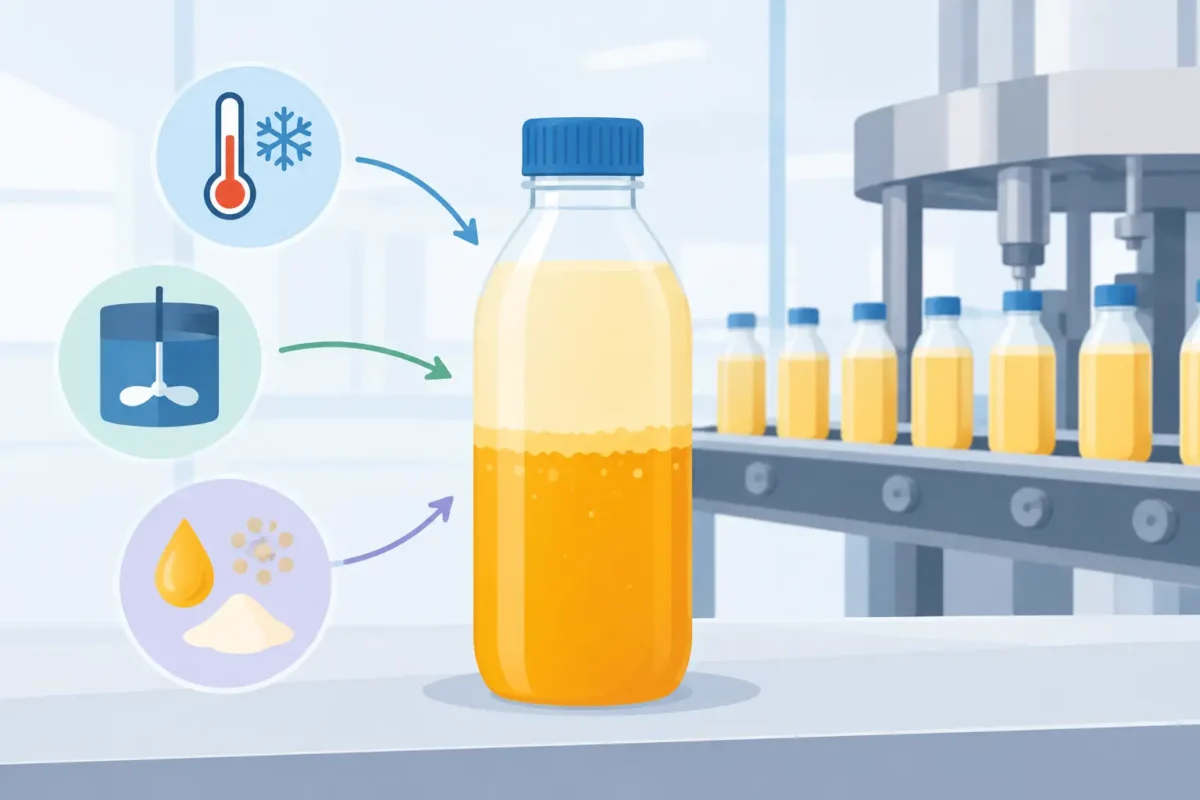
A drink can taste brilliant in a development kitchen and still fail the moment it sits on a retailer’s shelf. A sediment layer, floating oil ring or cloudy band through the bottle tells the customer something is wrong before they have taken a sip. Understanding what causes drink formula separation is therefore not a cosmetic technicality. It is central to product quality, shelf life and whether your brand is ready for commercial production.
For founders, the hard truth is that a formula is not finished when the flavour is right. It is finished when every batch delivers the same appearance, texture and experience after filling, distribution, storage and real-world handling.
What causes drink formula separation?
Drink separation happens when ingredients that were blended together can no longer remain evenly dispersed. The issue may appear as sediment at the bottom, cream or oil rising to the top, a visible layer in the middle, or particles clumping together. Each symptom points to a different formulation or process problem.
At its simplest, drinks separate because their ingredients have different physical properties. Water, oils, proteins, fibres, juices, minerals and botanical extracts do not naturally behave as one uniform liquid. Some are heavier than water. Some repel it. Some become unstable when exposed to heat, acid or oxygen. A commercially stable beverage needs the right formulation architecture and the right manufacturing process to keep those ingredients in place.
That does not always mean a drink must look perfectly clear. A natural juice drink, protein shake or botanical product may be expected to have some sediment, provided it is safe, controlled and communicates quality rather than neglect. The question is whether the product performs as intended for its category and customer.
The most common reasons drinks split or settle
Density and particle size
Heavier particles fall. This is basic physics, but it causes major challenges in functional drinks. Cocoa, fruit powders, plant proteins, minerals, fibre and certain botanical ingredients can all settle when their particles are too large or too dense for the liquid system.
A fine powder can still settle if the formulation has insufficient viscosity to suspend it. Equally, adding more thickener is not an automatic fix. It may create an unpleasantly heavy mouthfeel, reduce flavour release or make the product difficult to process through factory equipment. The commercial answer is usually a balance of particle reduction, appropriate stabilisation and processing conditions.
Oil and water are fighting each other
Flavour oils, omega oils, CBD alternatives, fat-soluble vitamins and some natural extracts need careful handling in a water-based drink. Without a properly designed emulsion, droplets combine and rise, leaving an oily ring or a distinct top layer.
An emulsifier can help keep oil droplets dispersed, but the choice depends on the drink’s pH, heat treatment, target shelf life and label requirements. A clean-label emulsifier may suit one brand proposition yet be less forgiving during scale-up than a conventional option. Founders need to assess this early, rather than committing to a label claim that makes the desired product performance impossible or prohibitively expensive.
pH, acidity and protein instability
Protein drinks are particularly vulnerable to separation. Milk proteins and many plant proteins can destabilise when acidity moves into the wrong range. A product designed around citrus flavour, for example, can become technically difficult when paired with protein because the acid may cause proteins to aggregate, form grainy particles or settle.
Heat treatment can intensify the problem. A formula that appears stable before pasteurisation may visibly split afterwards. This is why bench samples are useful, but never enough. The finished product must be tested under the actual thermal process and packaging format planned for launch.
Poorly matched stabilisers
Stabilisers, gums and hydrocolloids can hold particles in suspension, protect emulsions and improve mouthfeel. They are useful tools, not magic ingredients. The wrong type, dose or addition method can lead to clumping, stringy texture, haze, sediment or an unappealing gel-like consistency.
Many issues begin with hydration. Some powders need to be dispersed at a particular temperature, mixed at a specific shear level or allowed time to hydrate fully. If a factory adds ingredients in the wrong sequence, a recipe that worked at pilot scale can behave very differently in a large vessel.
Manufacturing shear and homogenisation
Homogenisation breaks droplets and particles into smaller, more stable sizes. It is especially relevant for emulsified drinks, dairy alternatives and products containing oils. Too little homogenisation can leave droplets large enough to rise and merge. Too much shear, however, can damage sensitive ingredients, alter texture or introduce processing complications.
The right setting depends on the formula and equipment. There is no universal pressure, mixing time or temperature that makes every beverage stable. This is one reason a founder should not rely on a manufacturer to “make it work” after approving an underdeveloped recipe. The process specification needs to be part of product development.
Temperature, time and transport
A drink may look stable immediately after production but separate after weeks in a warehouse or hours in a hot delivery vehicle. Temperature cycling is particularly revealing. Repeated warming and cooling can weaken emulsions, accelerate oxidation and cause insoluble material to drop out.
Shelf-life testing should reflect the route to market. Ambient products, chilled products and e-commerce shipments face different risks. A premium functional drink that will be stored in a warm stockroom, then shaken through a courier network, requires a more demanding stability plan than a product made for quick local consumption.
Separation is often a symptom, not the root problem
It is tempting to see sediment and reach for a stabiliser. That can mask the issue rather than solve it. The root cause may be an incompatible ingredient pair, an excessive active dose, incorrect pH, inadequate homogenisation or poor powder dispersion.
Start with the visual evidence. Does material sink, float, clump or create a haze? Does it happen after heat treatment, after a week, or only after cold storage? Does shaking restore the drink, and is that acceptable for the category? These observations narrow the investigation quickly.
Then assess the formula as a complete system, including water quality, ingredient specifications, flavour carrier, sweetener, acidity, processing method, pack type and intended shelf life. A change as small as switching one supplier’s botanical extract for another can alter particle size, oil content or solubility enough to destabilise the product.
How to prevent separation before it becomes expensive
The strongest approach is to design for stability from the first development brief. Be clear about the product’s commercial reality: its target format, pack size, storage temperature, shelf-life requirement, price point and manufacturing route. A recipe for a chilled short-life drink is not automatically suitable for ambient retail.
Use pilot trials to test the formula through realistic conditions, not just for flavour approval. That means examining the drink after processing and over time, including at elevated temperatures where appropriate. Measure pH, viscosity and particle behaviour consistently. Photograph samples so small changes are not dismissed as subjective impressions.
When working with functional ingredients, obtain proper technical data rather than relying on a supplier’s marketing description. You need to know whether the ingredient is soluble, heat stable, acid stable, light sensitive and compatible with the rest of the system. If it is not suitable for a ready-to-drink format, forcing it in can turn a promising brand idea into an expensive operational problem.
It also pays to set clear acceptance criteria. Decide what level of sediment, if any, is permissible; whether a “shake well” instruction is credible for your target customer; and what the product must look like at the end of its stated shelf life. These decisions influence formulation, packaging claims and customer expectations.
When a shake-well instruction is acceptable
Not every settled drink is a failed drink. Some categories, including juice-based products and certain natural wellness beverages, can carry a shake-well instruction without damaging trust. But it must be intentional. The sediment should redisperse easily, the product should still look appetising, and the pack should explain the reason in a way that supports the brand story.
For many products, especially premium clear drinks, protein beverages or beverages marketed for convenience, visible separation will be judged far more harshly. Consumers expect the drink to work without effort. If they have to question whether it is safe or properly made, the brand has already lost ground.
At Branding Innovations, formula development is treated as both a technical and commercial discipline. The aim is not merely to create a sample that tastes good in a meeting. It is to build a drink that can be manufactured consistently, survive its route to market and earn repeat purchase.
A stable beverage is not created by adding more ingredients until the layers disappear. It comes from making disciplined choices about what belongs in the bottle, how those ingredients interact and how the finished product will live beyond the development bench. Get that right early, and your drink has a far better chance of looking as good on shelf as it did in your original vision.