
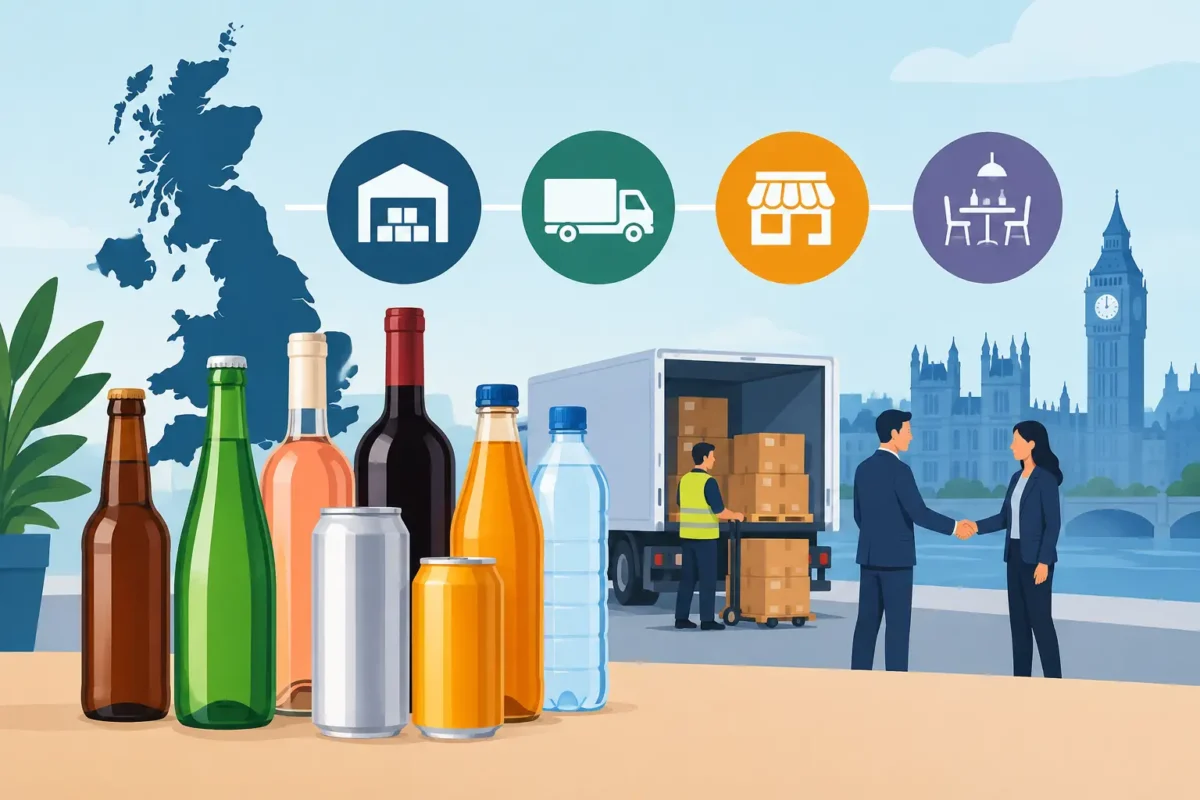
A drink can win a brilliant buyer meeting and still fail on the warehouse floor. If your case size is awkward, your margin is too thin, your shelf life is short or nobody can explain the product in ten seconds, wholesale will expose it fast. The best wholesale channels for drinks are not simply the biggest names on a target list. They are the channels that can repeatedly place your product in the outlets where your customer already buys.
For a new beverage brand, wholesale is a route to reach that would take years to build one shop at a time. It can put a functional can into gyms, cafés, convenience stores, offices, petrol stations and independent retailers. But it is not a shortcut around commercial reality. Wholesalers need a reason to list you, their customers need a reason to reorder, and your business needs enough cash to support the gap between production, stockholding and payment.
What makes a wholesale channel right for your drink?
Start with the occasion, not the wholesaler. A premium adaptogenic sparkling drink sold for a mid-afternoon energy lift has a different natural home from a value-led 500ml hydration bottle or a craft mixer. The first may earn traction through premium independents, gyms, cafés and specialist health retail. The second may need convenience, forecourt and foodservice volume. A mixer needs bars, restaurants and hospitality distributors that understand the serve.
The right channel also depends on your operational readiness. Most wholesalers will expect clear outer-case labelling, barcodes, reliable lead times, pallet configuration, agreed delivery terms and a credible sales story. They will also ask practical questions: What is the retailer or operator margin? What promotional support will you provide? How long is the shelf life on delivery? Is the product already moving anywhere?
That last question matters. Wholesale works best when it amplifies evidence rather than replacing it. A handful of strong local accounts, repeat online customers or a proven foodservice trial gives a buyer confidence that the brand will not become dead stock.
The best wholesale channels for drinks, by route to market
Regional wholesalers: the most realistic first move
For many startup drinks brands, regional wholesalers offer the best balance of access, learning and manageable risk. They know local independent retailers, cafés, caterers and hospitality operators, and their buying teams are often more open to a differentiated challenger product than a vast national operation with rigid ranging cycles.
A regional listing can show you where your drink actually sells. You may find that a wellness drink performs in university cafés rather than gyms, or that a premium soft drink takes off in delis but not corner shops. That insight is worth more than a vanity listing with a national name and no orders.
The trade-off is reach. You will need several regional partners to build broad coverage, and each may have different systems, terms and expectations. This requires active account management. Do not assume a listing equals distribution. Give the wholesaler a concise sell sheet, staff samples where appropriate, clear case economics and a reason for their sales team to mention you.
Cash and carry: useful when the product sells itself
Cash and carry can be a powerful route into independent convenience retail and foodservice because customers choose products directly from the depot. It works particularly well for drinks with obvious consumer appeal, competitive pricing and packaging that communicates quickly from a shelf.
The challenge is visibility. A new can placed among hundreds of established SKUs will not move because it exists. You may need introductory deals, tastings, depot activity or sales support to create pull. Your pack also has to work hard: flavour, functional benefit, pack format and price point must be immediately clear.
This route is less forgiving for complex propositions. If your drink needs a lengthy explanation of ingredients, dosage or usage, consider building understanding through specialist channels first. Cash and carry rewards clarity, not cleverness for its own sake.
Specialist foodservice distributors: ideal for the right serve
If your product belongs in a café, workplace, hotel, restaurant, leisure venue or contract caterer, a foodservice specialist may be more valuable than a general wholesaler. These partners sell into operators who care about menu fit, fridge space, gross profit and consistency of supply.
This is often the right route for premium soft drinks, cold brew, adult alternatives, functional refreshments and products that complement a food offer. The buyer is not only asking whether the can looks good. They are asking whether it earns its space in a chilled display or supports a profitable meal deal.
Be commercially honest here. Foodservice can involve longer sales cycles and smaller initial orders, particularly if a product must be approved centrally. However, one successful group rollout can create stable recurring volume. Build a clear serve recommendation, wholesale price, suggested selling price and a simple explanation of why the operator’s customer will choose it.
Convenience and forecourt distributors: built for frequency
Convenience and forecourt are attractive because drinks are bought frequently and on impulse. They suit single-serve formats, familiar flavour cues, accessible price points and products that solve an immediate need such as energy, hydration or refreshment.
They are also demanding. Retailers expect reliable availability, strong margins and brands that move quickly. A 330ml functional sparkling drink may look perfect for the channel, but it will struggle if its retail price is out of line with its perceived benefit or if the outer case is too expensive for a small store to commit to.
Use this route once your proposition is stripped back to its sharpest commercial message. “Natural energy with no crash” is easier to sell than a paragraph of botanical science. The science still matters, especially for compliant claims, but the shopper’s decision is made in seconds.
National wholesalers: scale after proof, not before it
National wholesalers can transform distribution, but they are rarely the best place to begin. Their scale brings access to thousands of customers, central systems and potential national promotions. It also brings listing requirements, longer payment cycles, demanding service levels and fierce competition for attention.
Approach national accounts with proof: repeat sales, strong customer feedback, dependable manufacturing capacity and enough working capital to withstand a serious purchase order. A large order is not automatically good news if it forces you into expensive short-run production, weak margins or stock you cannot replenish.
A founder should also understand the difference between being listed and being actively sold. Ask how the product will be presented to depots, telesales teams and customers. Clarify whether promotional activity is expected, what data is available and who owns the day-to-day relationship. A big wholesale partner still needs a brand owner who drives the opportunity.
Specialist health, premium and ethnic wholesalers: precision can beat volume
Specialist wholesalers are often overlooked because their customer base is narrower. That can be exactly their value. A low-sugar functional drink, kombucha, protein shake, culturally specific flavour profile or premium adult soft drink may find much faster acceptance through a wholesaler whose customers already understand the category.
These channels can create credibility and valuable consumer feedback before a broader push. They may also support a higher price architecture than mainstream convenience. The limitation is obvious: specialist distribution alone may not build the scale you want. Treat it as a focused launch pad, not necessarily the final route to market.
Build the economics before you pitch
A wholesale price that looks profitable on a spreadsheet can collapse once you include duty where relevant, freight, warehousing, samples, promotional funding, distributor margin, wastage and payment terms. This is where founders get caught out. They price from manufacturing cost, then discover there is not enough value left for every partner in the chain.
Work backwards from the realistic shelf price for your target outlet. Allow a viable margin for the retailer or operator, the wholesaler or distributor, and your own business. Then test the result against your minimum production run and the true landed cost of each unit. If the product only works at an unrealistic retail price, fix the model before going to market.
Shelf life is equally commercial. A wholesaler may reject a great product if it arrives with too little life remaining for their warehouse and customer cycle. Plan production and distribution around the life your channel needs, not the life that merely looks acceptable in a product specification.
Give buyers a commercial reason to say yes
Buyers are not looking for another founder with a nice-looking can. They are looking for a product that solves a ranging gap, creates margin, attracts a customer or answers a clear trend. Your pitch should make that case without theatre.
Bring a tight commercial pack: product samples, a one-page proposition, trade pricing, case and pallet details, shelf life, barcode information, launch plan and evidence of demand. If you have early sales data, use it. If you do not, show credible insight into the consumer and outlet opportunity, then propose a sensible trial rather than demanding a nationwide commitment.
This is also where experienced route-to-market support earns its place. Branding Innovations works with founders on the product, brand and buyer readiness that wholesalers expect, alongside access to an established network of manufacturers, suppliers, distributors and more than 6,500 buyers. The point is not to chase introductions before the business is ready. It is to arrive with a drink that can be listed, supplied and reordered.
Do not confuse distribution with demand
The strongest wholesale strategy creates pull from both sides. Customers ask for the product because they have seen it, tried it or heard about it. Wholesalers continue to stock it because outlets reorder. Your job after listing is to keep that loop moving through sampling, focused local activation, social proof, sales materials and direct conversations with key accounts.
Start where your drink has the clearest right to win, make the unit economics work before the first pallet leaves the factory, and measure reorders with ruthless honesty. The best channel is the one that turns your first listing into a repeatable commercial engine.