
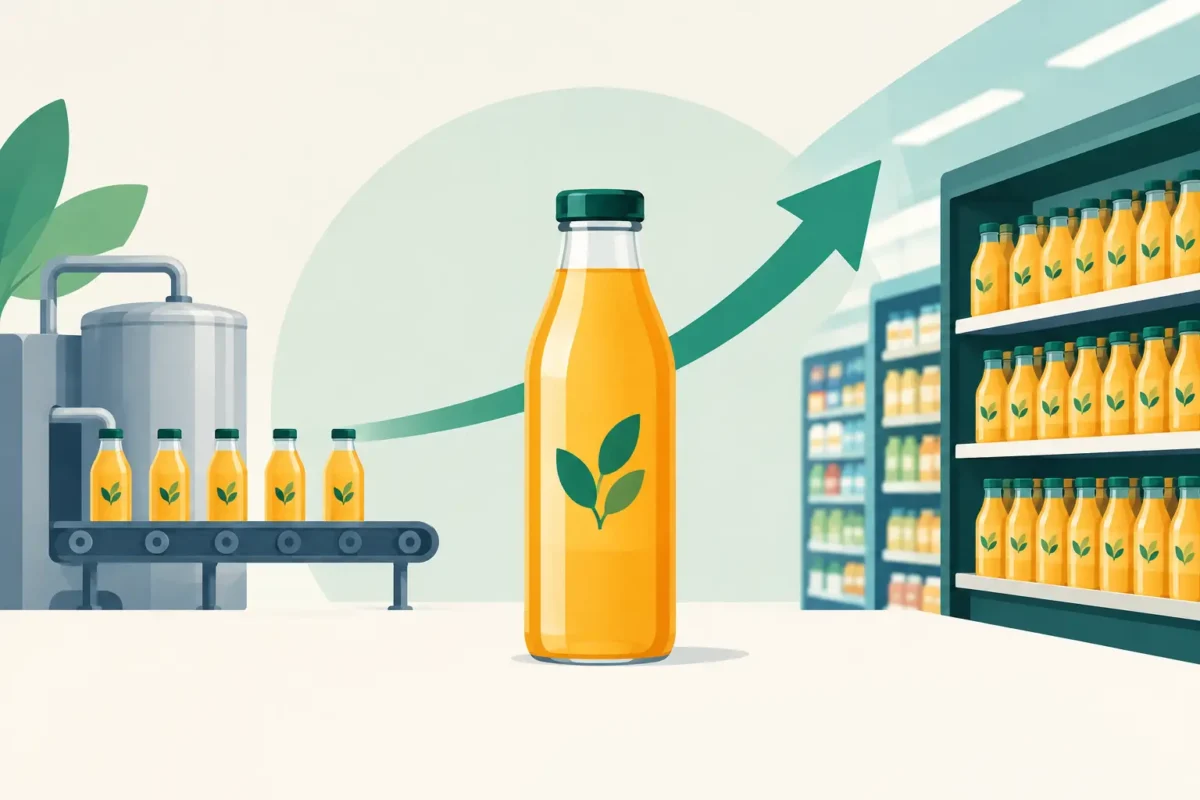
A great-tasting sample made in a home kitchen can win friends, investors and even an early buyer meeting. It cannot, on its own, win a place in a serious drinks range. What makes a drink scalable is its ability to be made repeatedly, legally, profitably and at the volume a customer needs – without losing the taste, quality or brand promise that made people care in the first place.
That is the point where many ambitious drinks founders get caught out. They have a strong idea, a compelling health proposition and a beautiful pack concept, but the product has not yet been designed for commercial reality. Scalability is not one technical hurdle at the end of development. It is a set of decisions made across formulation, sourcing, manufacturing, packaging, compliance and route to market.
What makes a drink scalable in practice?
A scalable drink has a formula that can be reproduced within tight tolerances, ingredients that can be sourced reliably, a production process suited to a credible manufacturer, and a cost base that leaves enough margin for every business in the chain. It must also survive its stated shelf life, meet UK labelling requirements and arrive in the consumer’s hands looking and tasting as intended.
Those elements are linked. A premium botanical may give your drink a distinctive edge, for example, but if its supply is seasonal, inconsistent or only available in small quantities, it can create a major growth problem. Equally, a low-sugar formula may fit the market brilliantly, but it still has to deliver sweetness, mouthfeel and flavour after processing and six months on shelf.
The right question is not, “Can we make this drink?” It is, “Can we make it again at 10,000, 100,000 and one million units, while protecting quality and making money?”
Start with a formula built for production, not the bench
Beverage development is where scalability is often won or lost. Early samples are commonly made by hand with precise weighing, fresh ingredients and unlimited attention. Factory production is less forgiving. Ingredients behave differently when mixed at speed, heated, filled, transported and stored under real-world conditions.
A commercially viable formula needs to be technically stable. That means managing pH, preservative strategy where appropriate, microbiological safety, separation, sedimentation, carbonation retention and flavour degradation. Functional ingredients add another layer of complexity. Vitamins, minerals, adaptogens, proteins and botanicals can affect taste, colour, solubility and shelf life. Some are sensitive to heat. Others interact with sweeteners or acids. A claim-worthy dose may also be an expensive dose.
There is no universal route. A chilled fresh product, an ambient still drink, a carbonated can and a dairy-based functional shake have very different processing requirements. Pasteurisation, hot-fill, aseptic filling and cold-chain distribution each bring different opportunities, costs and constraints. Choosing the process late can force expensive reformulation.
Taste remains non-negotiable. Consumers may buy a functional drink once because of its benefit, but repeat purchase depends heavily on whether they genuinely enjoy drinking it. A scalable formula must therefore balance efficacy, label appeal and sensory performance rather than treating health credentials as a substitute for flavour.
Build realistic ingredient specifications
A name on an ingredient list is not a specification. Founders need clarity on the exact grade, origin, active level, particle size, allergen status, lead time and acceptable alternatives for each key ingredient. Natural raw materials can vary from batch to batch, particularly colours, juices and botanicals. If your product only works with one supplier’s exact material, that dependency needs to be understood and managed early.
Where possible, identify approved alternatives before launch. This does not mean compromising your brand. It means protecting it from a single delayed shipment, crop issue or sudden minimum order quantity increase. The best time to test a substitute is during development, not when a production run is waiting.
Your manufacturer must be able to make the drink you designed
A concept is not scalable because a factory exists. It is scalable when the factory’s equipment, processes, certifications, minimum runs and technical capability suit the product.
Some manufacturers are excellent at carbonated cans but not still functional shots. Others can handle hot-fill PET but not sensitive ingredients requiring low-temperature processing. A co-packer may have a tempting minimum order quantity, yet the line speed, batch size or filling format could make your cost per unit unworkable. The cheapest quote is rarely the cheapest commercial decision.
Manufacturing due diligence should cover more than price. Look at technical fit, quality systems, capacity, production planning, ingredient procurement support, warehousing, lead times and willingness to grow with a challenger brand. Ask what happens when you need a second run quickly, when demand doubles, or when your chosen can or bottle is unavailable.
Pilot runs are valuable because they reveal issues that a lab trial cannot. You may see unexpected foaming, inconsistent fill levels, flavour loss after heat treatment or pack damage in transit. These are not failures to hide. They are the practical findings that stop a costly full-scale mistake.
Packaging has to work on line, on shelf and in transit
Packaging is often treated as a brand decision first. It is a commercial system. The pack needs to communicate quickly, meet legal requirements, work through filling equipment, protect the liquid, survive distribution and earn its space on shelf.
Cans, glass, PET, cartons and pouches each have trade-offs around cost, recyclability, barrier properties, weight, breakage risk and consumer perception. A premium glass bottle can support a high-end position, but it may add freight cost and reduce the margin available to a distributor. A slim can may look right for a modern energy or wellness proposition, but its dimensions and availability must suit the production line.
Artwork also has to be finalised with discipline. Last-minute changes can delay print slots, create obsolete stock and introduce labelling errors. Barcode setup, ingredient declarations, nutrition panels, allergens, deposit return requirements where relevant, claims and net quantity all need checking before print. A beautiful pack with a compliance failure is not launch-ready.
Margin is the test that turns ambition into a business
The drinks category has multiple mouths to feed. The manufacturer, brand owner, distributor, wholesaler and retailer all need a viable return. If your numbers only work when selling direct to consumer at full price, the product may not be ready for wholesale or grocery.
Build your cost of goods from the ground up: ingredients, packaging components, co-packing, outer cases, freight, storage, quality testing, wastage and any duties or levies that apply. Then model the trade margin required by the channels you want to enter. Promotional activity, introductory discounts, listing fees and payment terms can materially affect cash flow, particularly for a young brand.
A higher retail price is not automatically the answer. Price must make sense against the consumer’s alternatives and the value your product clearly delivers. Sometimes the right solution is a different pack size, fewer costly ingredients, a more efficient format or a focused launch through channels that support premium pricing. Cutting quality simply to hit a target cost is usually a false economy, especially when repeat purchase is still being earned.
Compliance protects the brand you are building
In FMCG, compliance is part of commercial credibility. Claims around health, energy, immunity, hydration or functional benefits must be carefully substantiated and presented correctly. The same applies to nutrition information, allergen management, ingredient naming and product descriptions.
This is particularly important for founders in the wellness space. The language that performs well on social media is not always permissible on pack or in retailer-facing materials. Overclaiming can lead to expensive reprints, rejected listings and damage to trust. A good development process builds compliance into the proposition from the start, so the brand does not rely on messages it cannot legally use.
Shelf-life validation matters too. You need evidence that the drink remains safe, stable and true to specification through its intended life. Retailers and distributors will rightly expect that confidence. Sending product into market with a hopeful best-before date is not a strategy.
Scale demand as carefully as you scale supply
There is little value in securing a large production run before proving who will buy the drink, at what price and often enough to justify repeat orders. Conversely, a strong trial response means little if you cannot supply the next order. Scalable brands align production planning with a realistic route to market.
Start with the channels that best fit the product and your resources. A functional shot may gain traction in gyms, health retail and convenience before a national supermarket conversation. A premium adult soft drink may need hospitality and specialist retail to establish its credentials. Different channels have different case sizes, margins, logistics requirements and buyer expectations.
The evidence buyers want is practical: clear positioning, a product that tastes right, credible pricing, reliable supply, compliant packaging and signs that consumers will come back. Big ambitions help, but commercial readiness opens doors.
Build scalability into every decision
The strongest drinks brands do not treat scale as something that happens after launch. They build for it from the first brief. That means being honest about the ingredient that is too expensive, the format a manufacturer cannot fill, the claim that will not stand up and the minimum run that could drain the business of cash.
At Branding Innovations, that is the work we focus on before a founder spends heavily on stock: turning a promising concept into a drink that can perform from the first production run to the next major listing. The goal is not simply to get a product made. It is to create a brand with the best chance of staying on shelf once it gets there.
A scalable drink is not the one with the most complicated formula or the flashiest launch plan. It is the one that delivers a clear reason to buy, every time, through a supply chain and commercial model built to keep up with success.