
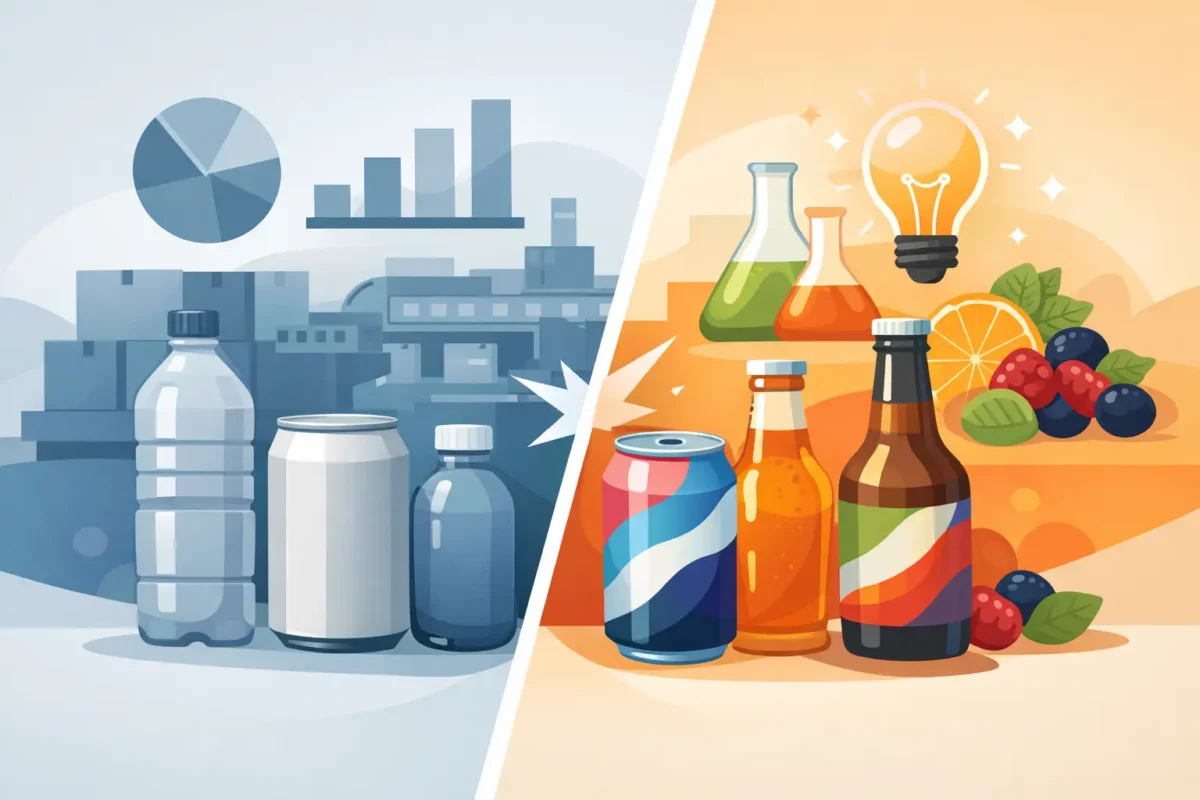
If you are serious about launching a drinks brand, the private label vs custom beverage decision will shape almost everything that follows – your speed to market, your upfront spend, your margins, your point of difference and, bluntly, your chances of building something that lasts.
Too many founders treat this as a packaging choice. It is not. It is a business model choice. And if you get it wrong early, you can burn cash on stock, waste months with the wrong manufacturing partner, and end up with a product that looks fine on a shelf but has no real reason to exist.
Private label vs custom beverage: the real difference
A private label beverage is an existing product made by a manufacturer and sold under your brand. The liquid is usually already developed, tested and production-ready. In most cases, your main decisions are around flavour selection, packaging format, label design and minimum order quantities.
A custom beverage is built from the ground up around your concept. That means recipe development, ingredient selection, nutritional targets, flavour work, technical trials, shelf-life testing, compliance checks, manufacturing fit and packaging choices are all tailored to your brand.
On paper, the trade-off looks simple. Private label is faster and usually cheaper to launch. Custom gives you more control and stronger differentiation. In practice, the right route depends on what you are trying to build.
If your goal is to test a market quickly with lower development risk, private label can be smart. If your goal is to create a credible challenger brand with a defendable proposition, custom is often the better play.
When private label makes commercial sense
Private label gets dismissed far too quickly by people chasing originality before they have earned market traction. That is a mistake.
For some founders, private label is the fastest way to get a branded product into the market, generate proof of demand and start building a customer base. If you already understand your audience, have a route into retail or hospitality, and need a product live quickly, speed matters. A lot.
Private label also reduces technical complexity. You are not spending months in formulation rounds or trying to force an unstable functional concept into production. The manufacturer has already solved many of the technical and operational issues, which can lower your early-stage risk.
This route can work especially well for trend-led products where brand, positioning and distribution matter more than deep product innovation. If your edge is audience access, community, content, or channel relationships, a well-chosen private label product may be enough to get moving.
But there is a hard truth here. If the product is available to multiple brands with only minor adjustments, your uniqueness is thin. That becomes a problem when buyers ask the obvious question: why should this brand win over the next one?
Where private label starts to fall short
The biggest issue with private label is not quality. Some private label manufacturers produce excellent liquids. The real issue is strategic control.
You are working within someone else’s framework. That means limited freedom on formulation, ingredients, claims, functional dosing, flavour architecture and pack format. If the market shifts, or you want to refine your proposition based on customer feedback, your room to move may be restricted.
Margins can also become tighter than founders expect. A product that seems cost-effective upfront can become expensive if your only lever is branding and your manufacturer controls most of the production economics. You may save on development, but give away flexibility later.
Then there is the branding problem. In a crowded category, design alone rarely carries a drinks brand for long. Attractive packaging might get you a first look. It will not usually create repeat purchase if the liquid feels generic or the proposition can be copied in weeks.
This matters even more in wellness and functional drinks. Consumers are getting sharper. They read claims, compare ingredients and notice when a product feels assembled for trend appeal rather than built with intent.
Why founders choose a custom beverage
A custom beverage gives you the chance to create a product with genuine market relevance. Not just something that looks different, but something formulated around a clear commercial opportunity.
That could mean developing a functional drink with meaningful active levels, reducing sugar without wrecking taste, solving a technical challenge around stability, or building a flavour profile that actually reflects your target customer rather than a supplier’s standard range.
This is where serious brand building starts. A custom product lets you align your recipe, claims, pack, pricing and go-to-market story around one coherent proposition. That gives buyers more confidence, gives consumers a clearer reason to choose you, and gives you a stronger base for long-term growth.
It also puts you in a better position if you want to scale. You are not just reselling a stock formula. You are building an asset – your own product, your own positioning, and ideally a formulation strategy that supports margin, repeat purchase and future line extensions.
For founders entering functional wellness, nootropics, better-for-you soft drinks, sports hydration or adult soft drinks, custom development is often what separates a real brand from a label stuck on a commodity product.
The trade-off with a custom beverage
Custom sounds exciting because it is. It is also slower, more expensive and less forgiving if you make poor decisions.
Recipe development takes time. So do sourcing, trials, specification work, shelf-life validation and manufacturer alignment. If your brief is vague or your expectations are unrealistic, the process drags. Founders often underestimate how much work sits between a good idea and a factory-approved product.
There is also a cash question. You are paying for expertise, R&D, testing and iteration before you generate sales. That investment can absolutely be worth it, but only if your concept has clear commercial logic.
This is where blunt advice matters. Not every drinks idea deserves a custom build. If your proposition is weak, the category is overcrowded, or your route to market is unclear, spending heavily on bespoke development may simply accelerate an expensive mistake.
Private label vs custom beverage for startups
Most startup founders do not need a philosophical answer to private label vs custom beverage. They need a commercially honest one.
If you have limited capital, need traction fast, and want to validate brand demand before investing deeper, private label may be the right first step. It can help you test pricing, audience response, messaging and sales channels with less technical friction.
If you are building in a category where differentiation is critical, where functional credibility matters, or where retailers will expect a more developed proposition, custom is usually the stronger route. It gives you a better story, stronger product-market fit and more control over your future.
Sometimes the best answer is phased. Start with a tightly selected private label product to test the market, then move into custom development once you have data, customer feedback and proof of concept. In other cases, that phased approach creates confusion and weakens the brand from day one. It depends on the category, the ambition and how central the liquid is to your value proposition.
That is why serious founders should not ask only, which option is cheaper? They should ask, what does this route allow my brand to become in 12, 24 and 36 months?
What buyers and consumers actually care about
Founders can get obsessed with development mechanics. Buyers do not. Consumers do not. They care about whether the product earns its place.
A buyer wants confidence that the drink has a clear market position, reliable supply, sensible pricing and a reason to sell. A consumer wants a product that tastes good, delivers on its promise and feels worth buying again.
If private label helps you meet those standards, fine. If custom helps you meet them better, even better. The mistake is assuming one route is automatically more credible than the other. Credibility comes from execution.
That said, when multiple brands are competing for shelf space, custom development usually gives you more ways to stand apart. More ownable flavour work. More meaningful claims. More strategic pricing. More room to evolve the range. That matters when the market gets tougher, not easier.
How to choose without wasting time and money
Start with your business ambition, not your ego. Are you testing a concept, building a saleable brand asset, or trying to hit a retail window quickly? Be precise.
Then look at the category reality. If your target market is saturated with near-identical products, private label may leave you exposed unless your brand and route to market are exceptionally strong. If the category is more operational than innovative, private label could be perfectly viable.
Next, stress-test your budget properly. Not just development cost, but stock holding, packaging, compliance, freight, cash flow and promotional spend. A custom product that you cannot support commercially is not a smart move. Neither is a private label product with weak margins and no upgrade path.
Finally, get experienced input early. This is exactly where specialist partners such as Branding Innovations add value – not by flattering founders, but by pressure-testing the concept, identifying the fastest viable route, and making sure product, brand and commercial strategy are built to work together.
The best launch route is the one that gives your brand the best chance of surviving contact with the real market. That is not always the most exciting option. It is the one that stands up when buyers ask hard questions, consumers spend real money, and growth stops being a pitch deck and starts becoming operations.