
Visibility Is Not an Accident. It Is a Strategy.
Your product is on the shelf, website is live and Instagram account is active. And yet consumers are not finding you. Buyers are not returning your calls. Sales are not building the way they should.
This is not a product problem. In most cases, it is a visibility problem. And a visibility problem is what a great food marketing agency exists to solve.
In 2025, brand visibility for food and drink brands is more complex and more commercially critical than it has ever been. Consumer discovery has shifted online. Social media drives purchasing decisions. Search engines and AI tools are the new shelf. And the regulatory environment is tightening the channels available to brands that have not been built correctly from the start.
The food brands growing fastest in 2025 are not the ones with the biggest budgets. They are the ones with the most precisely built visibility strategy deployed across the right channels, in the right format, to the right audience, at the right moment.
This article breaks down exactly what a food marketing agency should deliver, what brand visibility actually means in 2025, and how Branding Innovations builds the visibility strategy that turns a good food brand into a market leader.
Why Brand Visibility Is the Defining Commercial Challenge in 2025
The UK food market in 2025 is simultaneously the most transparent and the most crowded it has ever been. Consumers have more information, more choice, and more scepticism than any previous generation of buyers.
Companies with strong brand awareness outperform competitors in purchase intent by more than three times. 50% of consumers are more likely to buy from brands they recognise. Brand visibility is not a vanity metric; it is the primary commercial multiplier that determines whether all other marketing investments convert into sales.
The food and drink sector is undergoing a seismic shift. Digital platforms, especially social media, are no longer optional. They are essential for building brand visibility and consumer trust. Digital marketing is now a transformative force, creating opportunities for food and drink brands to connect with consumers in a more authentic and personalised way.
In the food market, competition is fierce, and differentiation rarely depends on the product alone. What truly distinguishes a brand is its ability to be remembered, generate trust, and become part of consumers’ daily lives. An effective food marketing plan enhances visibility, builds brand awareness, drives customer loyalty, and increases sales throughout the entire funnel.
The implications are clear. A food brand without a structured visibility strategy is not competing on a level playing field. It is invisible while its competitors are seen.
What Brand Visibility Actually Means for a Food Brand in 2025
Brand visibility is not just about being seen. It is being seen by the right people, in the right context, at the right moment consistently enough that recognition builds into trust, and trust converts into purchase.
For a food brand in 2025, visibility operates across five distinct layers:
Consumer Visibility — being discovered by the end consumer through social media, search, online retail, and in-store placement. This is the layer most founders focus on first, and often the one they build incorrectly because the deeper layers are not in place.
Retail Buyer Visibility — being known to and trusted by the buyers at Tesco, Sainsbury’s, Holland & Barrett, Planet Organic, and Ocado, who decide what appears on the shelf. A brand invisible to buyers is a brand that cannot scale, regardless of consumer demand.
Category Visibility — being positioned clearly within a specific category or segment so that consumers and buyers immediately understand what the product is and who it is for. Vague positioning produces vague visibility.
Digital Visibility — being findable through search engines, AI discovery tools, and online retail platforms. New product discovery largely happens online, through social networks, search engines, and delivery platforms. Understanding and managing these touchpoints is crucial for influencing consumer decision-making.
Credibility Visibility — being seen by consumers as trustworthy, authentic, and worthy of their money. 81% of consumers need to be able to trust a brand to buy from it. Trust is built through consistent messaging, authentic content, transparent ingredient communication, and third-party validation.
A food marketing agency that only addresses one or two of these layers produces partial visibility, which is why so many food marketing campaigns fail to translate into sustainable sales growth.
The UK Food Marketing Landscape in 2025: What Has Changed
Understanding the environment that food marketing agencies operate in is an essential context for every brand visibility decision in 2025.
Digital Is Now the Primary Discovery Channel
Greggs and Innocent Drinks have mastered the art of community-building through social channels, turning followers into loyal customers. Starbucks has gone a step further, using AI and analytics to personalise offers, rewarding repeat visits and deepening customer engagement. Digital marketing is now a transformative force, creating opportunities for food and drink brands to connect with consumers in more authentic and personalised ways.
89% of marketers report an increase in brand exposure through social media. 72% of consumers prefer to learn about a product through video. These figures reflect a consumer behaviour shift that is now structural, not cyclical.
Consumer Trust Is the New Currency
People are more sceptical in 2025. They research more. They hesitate longer. And increasingly, trust is the deciding factor not price, not promotions, not even convenience. Two brands with similar products and similar pricing can have entirely different commercial trajectories based on which one consumers trust more.
92% of consumers trust recommendations from people they know. 81% of consumers need to trust a brand before they buy from it. Building trust is not a brand exercise; it is a commercial imperative that affects every revenue metric a food brand tracks.
HFSS Restrictions Are Reshaping Paid Media
The HFSS advertising watershed restricting paid digital advertising and pre-9 pm TV ads for qualifying products has created a fundamental shift in how food brands must build visibility. Brands affected by HFSS restrictions must shift their visibility strategy toward organic social media, SEO, out-of-home advertising, podcasts, and earned media channels that deliver strong results and are fully exempt from the new regulations.
This makes organic brand building through content, community, and credibility more commercially important than it has ever been. And it makes choosing a food marketing agency that understands the HFSS landscape a non-negotiable.
SEO Has Become a Survival Tool
Online visibility not only helps food brands reach a wider audience but also allows them to showcase their unique offerings and build trust with customers. By establishing a strong online presence, food brands gain a competitive edge and position themselves as a go-to choice for their target consumer.
Food-related searches, recipes, ingredient benefits, dietary choices, and specific product categories represent enormous organic traffic opportunities for brands with the authority to rank. A food marketing agency that cannot deliver SEO is leaving the most sustainable long-term visibility channel entirely unaddressed.
What a Food Marketing Agency Should Deliver for Brand Visibility
The services that genuinely move the needle on food brand visibility in 2025 are not generic. They are food-specific, commercially targeted, and built on a deep understanding of how UK consumers discover, evaluate, and buy food products. Here is what a genuine food marketing agency delivers:
| Service | Visibility Impact | Why It Matters in 2025 |
| Brand Positioning Strategy | Foundation of all visibility | Without clear positioning, no channel produces consistent recognition |
| SEO and Content Marketing | Long-term organic discovery | AI and search-driven discovery is now the primary new consumer touchpoint |
| Organic Social Media Management | Daily consumer visibility | Exempt from HFSS restrictions; the highest discovery rate for food brands |
| User-Generated Content Strategy | Trust-led visibility | Most credible form of social proof; drives purchase intent |
| Packaging Design | Point-of-sale visibility | The first and most frequent consumer touchpoint for any food brand |
| Trade Marketing and Buyer Presentations | Retail channel visibility | Consumer demand without retail access generates no revenue |
| PR and Earned Media | Credibility visibility | Third-party editorial coverage builds the authority that advertising cannot buy |
| Email Marketing | Owned audience visibility | Highest ROI channel; fully owned, fully exempt from advertising restrictions |
| Website Optimisation | Digital hub visibility | The shop window is every buyer and consumer visits before making a decision |
| Amazon and E-commerce Strategy | Online retail visibility | Growing share of UK food discovery and first purchase |
The Visibility Killers: Why Most Food Brands Struggle to Be Seen
Before building a visibility strategy, it is essential to understand the most common reasons food brands remain invisible despite marketing investment. These are the patterns Branding Innovations sees repeatedly across the market.
No Clear Positioning
A brand that tries to appeal to everyone appeals to no one. Positioning is the foundation of visibility because a brand without a precise positioning does not give consumers or algorithms a consistent signal to latch onto. Every channel produces weak, inconsistent results because the message it carries is too broad to resonate.
What truly distinguishes a food brand is its ability to be remembered. An effective food marketing plan enhances visibility by ensuring that every piece of content evokes trust and inspires curiosity rather than selling directly.
Poor Packaging That Fails at the Point of Sale
The most visited marketing touchpoint for any food brand is its packaging. A consumer who sees a food brand’s packaging in a supermarket aisle, in a social media post, or on an e-commerce listing is encountering the brand’s primary visibility asset. Packaging that fails to communicate clearly, compellingly, and distinctively in under three seconds generates no conversion regardless of how much is spent on every other channel.
No SEO or Content Strategy
Search engine visibility is essential for food brands. Food-related searches, recipes, gourmet products, and nutritional advice represent significant organic traffic opportunities. A well-structured food SEO strategy turns search intent into brand discovery and purchase.
A food brand with no SEO strategy is invisible to the consumer who searches for “high-protein snack UK,” “best gut health drink,” or “functional mushroom coffee” searches that represent active, high-intent purchase behaviour. This is one of the most commercially valuable visibility gaps a food marketing agency can close.
Social Media Without Strategy
Posting on social media without a content strategy, a consistent brand voice, or a clear audience is not marketing it is noise. The food brands building genuine visibility on social media in 2025 are doing so through specific, authentic, community-driven content built around a clear consumer identity. Random posts with no strategic framework produce random, unmeasurable results.
Marketing Without Buyer Access
A consumer marketing strategy that builds awareness but has no route to retail is an incomplete visibility plan. Consumers who want to buy a product and cannot find it in the channel they prefer, their local supermarket, an online retailer, or a gym café, do not wait. They buy a competitor’s product instead.
How Branding Innovations Builds Food Brand Visibility
At Branding Innovations, the team builds food brand visibility on a principle that separates the agency from generic creative and digital shops. Strong visibility requires a strong foundation. Before the team activates any marketing channel, they ensure the product, brand identity, and market positioning are fully aligned.
This means the visibility strategy begins not with a campaign brief but with a brand audit, an honest, structured assessment of whether the product, the positioning, the packaging, and the compliance are ready to support a visibility campaign that converts.
Most brands fail with traditional agencies because they only get marketing, not strategy. A professional food marketing agency at the highest level helps brands develop the product, build the brand, and then market it. The goal is simple: turn your food product into a scalable brand.
Here is how the Branding Innovations visibility-building process works in practice:
Step 1 — Brand Audit and Visibility Gap Analysis
Every project begins with an honest assessment of where the brand currently sits and where the visibility gaps are. This covers market positioning, packaging effectiveness, digital presence, SEO performance, social media content quality, and buyer relationships. The audit identifies exactly which layers of visibility are weak and which interventions will produce the highest commercial return.
Step 2 — Positioning Sharpening
If the positioning is vague, no marketing channel will produce consistent results. Branding Innovations sharpens the positioning to a single, specific, credible consumer promise communicated consistently across every touchpoint. This is often the single highest-leverage intervention available to a food brand struggling with visibility.
Step 3 — Packaging and Visual Identity
Everything is important, down to the meaning of colourways, patterns, and logos. A great brand makes a product influential and adaptable to future trends and clearly communicates to its target audience.
If the packaging is not earning attention at the point of sale on the shelf, on screen, or in a social media post, the brand development work is completed before any marketing campaign is activated. Building visibility on packaging that does not convert is pouring budget into a leaking vessel.
Step 4 — SEO and Content Strategy
Branding Innovations builds SEO and content strategies that make food brands findable by consumers searching for their category, by buyers researching new brands before agreeing to a meeting, and by AI discovery tools that are increasingly the first point of reference for product recommendations.
Appearing prominently on search engines helps brands capture sales while educating consumers and buyers about the product. The right SEO strategy can achieve strong Google rankings quickly and cost-effectively. More food and drink brands now sell online through Amazon and Shopify than ever before.
The content strategy covers the topics, formats, and publication cadence that build organic authority over time turning the brand into a trusted resource in its category, not just a product with a website.
Step 5 — Organic Social Media
Every day, customers sharing your food online, user-generated content builds trust faster than any advertisement. Encouraging happy customers to post, tag, and review creates content that is limitless and free. When your customers become your marketers, your content becomes a community asset.
Branding Innovations builds organic social media strategies that create a genuine community around a brand, not just follower counts. The content pillars are built directly from the brand positioning, so every post reinforces the brand promise rather than diluting it.
Step 6 — Buyer Visibility and Trade Marketing
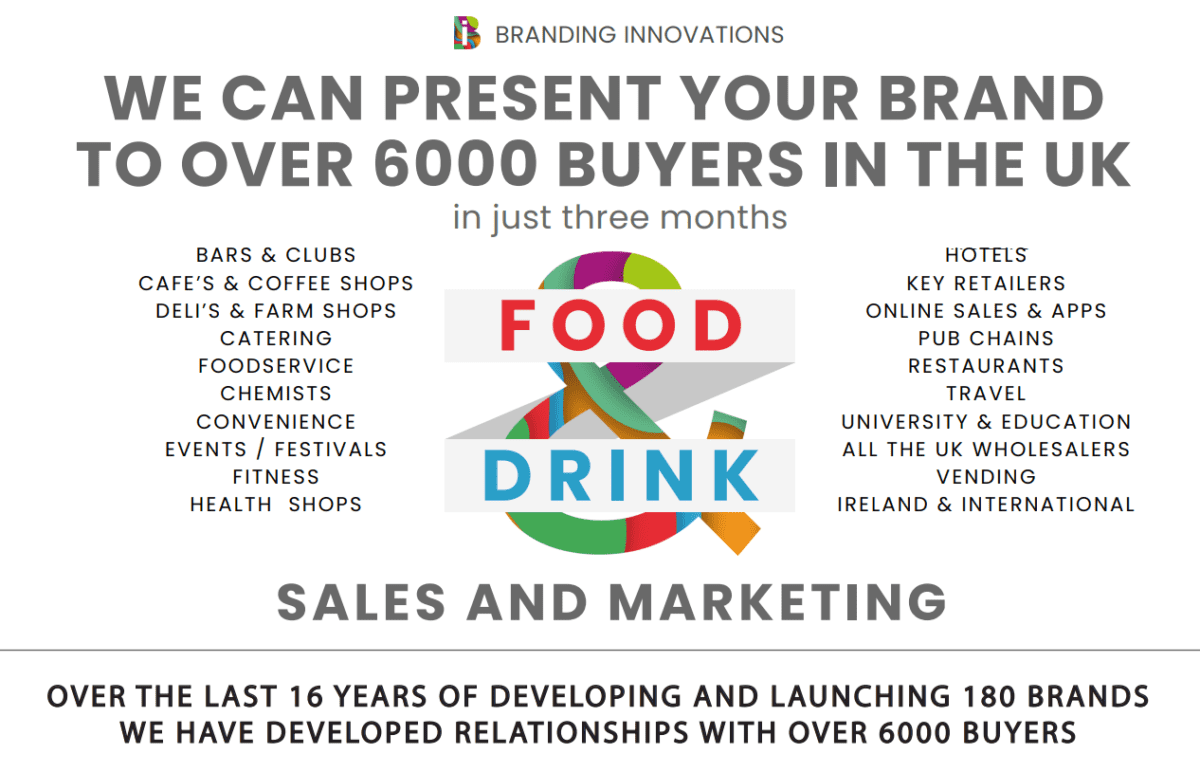
The agency maintains a database of over 6,500 UK and international buyers covering major supermarkets, convenience chains, health stores, gyms, universities, foodservice operators, and online platforms. This direct buyer access transforms consumer marketing investment into retail distribution, the channel where demand becomes revenue.
Every brand launched through Branding Innovations gets a tailored list of target buyers, a professional buyer presentation, and a warm introduction strategy built on 20 years of relationship-building across the UK and international retail landscape.
The Visibility Channels That Work for Food Brands in 2025
Every food marketing agency should be making channel decisions based on evidence, not convention. Here is the channel landscape for food brands in 2025:
| Channel | Visibility Impact | Cost Efficiency | Consumer Trust Level |
| Organic Social (TikTok, Instagram) | Very High — primary discovery channel | High — organic reach | Growing — authenticity drives trust |
| SEO and Blog Content | Very High — long-term compound growth | Very High — low ongoing cost | High editorial authority builds credibility |
| Email Marketing | High — owned, direct, measurable | Highest ROI of all channels | Very High — opted-in audience |
| User-Generated Content | Very High — social proof at scale | Very High — essentially free | Highest — peer recommendation trusted by 92% |
| Packaging Redesign | Very High — most frequent consumer touchpoint | One-time investment | Instant — communicates quality at the point of sale |
| PR and Earned Media | High credibility through third parties | Medium — requires relationship and story | Very High — editorial trust exceeds advertising trust |
| Out-of-Home Advertising | High — mass reach in a compliant format | Medium — location-specific spend | Medium — brand recognition building |
| Trade Marketing | High — retail channel visibility | High — ROI through listings secured | Very High — buyer trust built through a relationship |
| Podcast Sponsorship | Growing — engaged, attentive audiences | Medium | High — host endorsement carries credibility |
| Influencer Partnerships (UGC-led) | High — authentic advocacy | Medium — partner selection critical | High when authentic; low when visibly paid |
The Team Behind Branding Innovations’ Visibility Results
Richard Horwell founded Branding Innovations after 35 years in FMCG across the UK, USA, Australia, and the Middle East. He has personally overseen the development, branding, and launch of over 200 food and drink brands worldwide. Dr. Lilla Bessenyei is a qualified chemist specialising in nootropics, adaptogens, superfoods, and functional wellness ingredients. Her scientific expertise ensures every health claim in a brand’s marketing remains substantiated, compliant, and credible, creating the consumer trust that makes marketing both visible and believable.
Claire leads recipe development with 40 years of food science experience. The product must earn repeat purchase, and Claire’s formulation work ensures it does, every time.
Branding Innovations are at the top end of what they do. Their vast hands-on experience and creative approach to brand design and strategy have already led to over 180 successful new brands being launched into the market. The team are experts in their fields and will guide you through the whole process, highlighting pitfalls and hurdles that you might not expect. They are brutally honest — where others might not be — to ensure your products have the best chance to succeed in an extremely competitive market.
Clients, including VitClear, went from concept to distribution in six months. Actiph Water launched into Tesco, Sainsbury’s, Harrods, and Whole Foods simultaneously, subsequently raising $9.8 million in total investment and exporting to 15 countries.
You can explore the full Branding Innovations service offering here or learn more about the brand development process that underpins every visibility strategy the agency builds.
What Separates Brands That Get Seen From Those That Stay Invisible
| Invisible Food Brands | Visible Food Brands |
| Generic positioning — appeal to everyone | Precise positioning — speak directly to one consumer |
| Packaging that fails to communicate at a distance | Packaging that earns attention in three seconds |
| No SEO strategy — invisible to search | Authority-building content — ranks for category searches |
| Random social media posting | Consistent content strategy with clear audience and voice |
| No buyer relationships | Direct access to 6,500+ UK and international buyers |
| Paid ads only — no organic presence | Organic-first strategy that compounds over time |
| Marketing without compliance review | Compliant marketing strategy across all channels |
| One-time campaigns | Sustained visibility strategy built for long-term growth |
| No UGC strategy | Community built around authentic consumer advocacy |
| Website as a brochure | Website as a conversion and buyer credibility tool |
Frequently Asked Questions
What does a food marketing agency do to improve brand visibility?
A specialist food marketing agency builds visibility across every layer of consumer discovery through SEO and social media, retail buyer access through established relationships, point-of-sale conversion through packaging, and trust-building through credible content and PR, all aligned to a single, clear brand positioning.
Why is my food brand not getting visibility despite having a good product?
Most food brand visibility problems stem from weak positioning, packaging that fails to communicate at the point of sale, no SEO or content strategy, and a lack of direct buyer access. A great product is the foundation, and visibility is what makes it commercially viable.
How long does it take for a food marketing strategy to produce results?
Paid advertising produces immediate visibility but stops when spending stops. SEO and content marketing compound over 6 to 12 months and build durable organic visibility. The most effective strategies combine both organic authority as the long-term foundation and targeted paid promotion for specific campaign moments.
How does HFSS regulation affect food brand visibility in 2025?
Products classified as HFSS under the Nutrient Profiling Model face restrictions on paid online advertising and pre-9 pm TV ads. This makes organic social media, SEO, email marketing, out-of-home advertising, and earned media critically important for visibility channels that are fully exempt from HFSS restrictions.
Does a food marketing agency help with retail buyer visibility?
The best ones do. Branding Innovations maintains a database of 6,500+ UK and international buyers, with direct buyer access that converts consumer-level visibility into retail distribution and commercial revenue.
How does Branding Innovations approach food marketing differently?
Branding Innovations builds brands before it markets them, covering recipe development, brand identity, packaging design, regulatory compliance, and production management alongside marketing strategy. This means the product, the brand, and every marketing channel all tell the same story.
Ready for Better Brand Visibility?
Visibility is not a luxury for a food brand. It is oxygen. Without it, the best product in the world sits unseen on a shelf, undiscovered in a search result, and unknown to the buyer who could have listed it nationally.
A great food marketing agency builds visibility strategically across the right channels, for the right audience, on a foundation of positioning, packaging, and compliance that makes every marketing pound work harder.
At Branding Innovations, the team has built brand visibility for over 200 food and drink brands worldwide since 2008. The approach is the same every time: get the foundation right, build the channels correctly, and activate the buyer relationships that turn consumer visibility into commercial distribution.
If your food brand needs better visibility in search, on social media, on the shelf, or in front of retail buyers, start with a free consultation today. The team gives honest feedback from the very first conversation and takes on only projects with genuine market potential.
Read our Book for Guidance
Branding Innovations is a UK-based food and drink development and branding agency based in London. The team specialises in recipe development, brand strategy, packaging design, production management, and market launch all under one roof. With over 200 brands launched worldwide since 2008, the agency brings real commercial experience to every new project.