
The UK Drinks Market Has Never Offered More Opportunity or More Competition
The UK drinks industry in 2026 is undergoing one of the most significant category shifts in its history. Traditional brands built on sugar, artificial stimulants, and mass-market positioning are losing ground. New drinks brands UK founders are building are capturing the categories they are vacating functional, natural, honest, and purposeful.
But the scale of the opportunity is matched by the scale of the competition.
Only one in ten new food and drink brands survive beyond two years. The UK drinks market in 2026 is simultaneously the most exciting and the most demanding it has ever been. The functional drinks wave is real and growing. Consumer demand for natural, clean-label, health-positive beverages has never been stronger. Retail buyers are actively looking for the next brand that will excite their shoppers and fill gaps in their ranges. But the market does not reward good intentions it rewards preparation, product quality, and professional execution.
This guide covers everything a founder needs to understand about the UK drinks market in 2026 the categories growing fastest, the brands setting the standard, what separates the ones that succeed from the ones that disappear, and how to build a drinks brand UK consumers and buyers will actively choose.
The UK Drinks Market in 2026: The Numbers Behind the Opportunity
Understanding the scale and direction of the market is the foundation of any intelligent brand decision.
The UK functional beverage market was projected to reach £2.4 billion in value, with around 31% of UK consumers now consuming energy-boosting drinks regularly. Around 15% of UK consumers now consume herbal or adaptogenic drinks on a regular basis.
Waitrose’s sales of no and low-alcohol drinks shot up by nearly 20% in 2024, noting the growing trend for zebra-striping where consumers alternate between alcoholic and non-alcoholic drinks to maintain a healthier lifestyle. No and low-alcohol products saw a 600% sales spike since 2022 across multiple UK retailers.
The global functional beverage market reached $163.84 billion in 2026 and is forecast to grow at a 7.93% CAGR through 2031. The UK sits at the heart of this growth one of Europe’s most active markets for new drink brand launches, functional innovation, and clean-label product development.
The UK’s no and low-alcohol drinks market was predicted to be worth £380 million by the end of 2024, before growing to as much as £800 million by 2028.
These numbers describe a structural market shift not a short-term trend. The categories growing fastest are not growing because of marketing. They are growing because consumer behaviour has fundamentally changed.
The Six Highest-Opportunity Categories for Drinks Brands UK in 2026
Understanding which categories offer genuine commercial opportunity and which are already saturated is the most important strategic decision a new brand makes before investing a single pound.
1. Functional and Nootropic Drinks
Topping the functional drink charts are those infused with nootropics such as functional mushrooms which aid both relaxation and focus, CBD for inflammation and wellbeing, and minerals and adaptogens for enhanced hormone health such as magnesium and ashwagandha.
Brands including TRIP (CBD sparkling water), Moment (adaptogen-infused botanicals), DIRTEA (mushroom drinks), and PerfectTed (matcha-based) are carving out significant positioning in the adaptogen and nootropic space. Around 15% of UK consumers now consume herbal or adaptogenic drinks regularly.
The market is growing but it is not yet saturated by quality independent brands. A new drinks brand UK with a specific, credible functional positioning and a genuinely great taste profile can still secure a meaningful position in this category.
2. No and Low-Alcohol Beverages
The demographic for alcohol-free or low-alcohol beers, spirits, and cocktails is vast ranging from Gen Z who are drinking less than the generations before them, to Millennials who are alternating between alcohol and alcohol-free, and those who are more generally cutting back to improve their lifestyle.
The sober curious movement has evolved beyond a trend into a full-scale market opportunity. New social concepts such as soft clubbing are gaining traction, with coffee clubbing events growing 478%, showing how caffeine and community are replacing traditional nightlife for a growing consumer segment.
The no and low-alcohol category has transformed the UK drinks market. The next step is creating entirely new beverage categories that offer complexity and depth without relying on alcohol. Alcohol-free brands are moving beyond replication of alcoholic drinks toward genuinely new products with their own identity.
3. Gut Health Beverages
The kombucha category has expanded rapidly, with brands like Remedy Kombucha making gut-friendly drinks more accessible. The next frontier is prebiotic sodas brands like Olipop are already proving that functional soft drinks can support gut health while tasting great.
Gut health is increasingly on consumers’ radars globally. There is a growing interest in a holistic approach to wellbeing, often with a focus on the connection between gut and overall health. To help meet the daily fiber shortfall, water brands are launching fiber-infused sparkling water.
The gut health drinks category is early enough in UK mainstream retail that a well-positioned, genuinely functional brand still has meaningful first-mover advantage.
4. Premium No and Low-Sugar Soft Drinks
Shoppers outside the health-first functional category are looking for interesting, quirky juices, juice shots, anything containing matcha, and premium craft sodas taking cues either from global flavors seen on social media or from nostalgic, traditional tastes from childhood.
Low-calorie and low-sugar products are affected by both HFSS regulations and a fundamental shift in consumer perception. The ongoing conversation around ultra-processed foods means consumers are seeking out more natural options. Brands and retailers that can combine trending flavor profiles with natural, calorie-free sweeteners are onto a winner.
5. Women’s Wellness Drinks
One of the most exciting emerging categories is drinks targeting specific wellness needs for women particularly around energy, mood, and hormonal balance. Umri is leading the charge with fruit and herb infused drinks formulated specifically for women’s wellbeing, particularly during menopause.
This category is commercially underserved. A drinks brand UK built around women’s health with credible ingredients, clear functional positioning, and honest communication has genuine category-creating potential.
6. RTD Cocktails and Premium Mixers
RTD cocktails have generated massive appetite, with growth indicated at nearly 50% between 2018 and 2022. The popularity of RTD cocktails has spilled over into canned wine, with canned wine from a favorite brand appealing to 40% of drinkers or 61% of 18 to 34-year-olds primarily because the format helps them moderate.
The RTD format works for drinks brands because it delivers the premium on-trade experience in a retail-friendly, portable format. For new drinks brands UK entering this space, the opportunity is in premium, clean-label formulations that justify a higher price point and stand out from generic RTDs.
What Separates UK Drinks Brands That Succeed From Those That Fail
Branding Innovations has been behind over 200 food and drink brands worldwide since 2008. The pattern of success versus failure is consistent across every category and every year.
Successful Drinks Brands UK: The Common Factors
- They identify a specific gap before building a product. Not a category they like a specific consumer need that is not being met, at a specific price point, in a specific retail context. The more precisely this is defined, the stronger every subsequent decision becomes.
- They build brand and recipe simultaneously. The recipe must deliver on the brand promise. The brand must accurately communicate what the recipe delivers. When these are developed separately as they are when founders use disconnected suppliers the result is a product and identity that feel misaligned. Consumers sense it immediately.
- They invest in packaging that converts. A consumer in a UK supermarket makes a purchase decision in under three seconds. Packaging that cannot communicate the brand’s core proposition in that window loses the sale before the product is ever tasted.
- They get compliance right before production. A brand that discovers a Novel Foods issue, an unapproved health claim, or an HFSS classification problem after production has been committed faces delays and costs that most early-stage brands cannot absorb.
- They launch in the right channel first. Always start with premium retailers independent health stores, Whole Foods, Planet Organic, and specialist wellness retailers. Build velocity data there. Then approach major multiples with evidence, not ambition.
- They have access to buyers. Getting a listing at Tesco, Sainsbury’s, or Holland & Barrett is not about cold emails. It is about relationships built over years with buyers who trust the source of an introduction.
Failing Drinks Brands UK: The Common Mistakes
If you see a mass of products in a category such as kombucha it is highly likely you are too late. The only way to get into a category like this is by being cheaper than the competition or investing far more money in marketing than they are. Neither of these options is recommended. Most brands that fail do not stand out anywhere near enough to make a real difference in the market.
The table below summarises the full comparison:
| What Failing Drinks Brands Do | What Successful Drinks Brands Do |
| Enter saturated categories on enthusiasm alone | Identify underserved gaps through structured market research |
| Build product first, brand second | Develop recipe and brand positioning simultaneously |
| Use a kitchen recipe for commercial production | Invest in professional recipe development from day one |
| Skip or delay compliance review | Complete Novel Foods, allergen, HFSS, and health claims review before production |
| Approach major supermarkets first | Build velocity data at independents before approaching multiples |
| Cold outreach to buyers | Warm introductions through established buyer relationships |
| Generic positioning | Single, specific, credible functional or taste positioning |
| Over-complicated messaging | One primary promise, clearly communicated in three seconds |
| Launch everywhere at once | Targeted channel launch with clear velocity-building strategy |
| Underinvest in working capital | Budget minimum two years before expecting meaningful profitability |
The UK Drinks Consumer in 2026: What They Actually Want
Building a drinks brand UK buyers will list and consumers will choose requires a precise understanding of what is driving purchasing behavior right now.
Function Is Expected, Not a Premium
British consumers are highly focused on wellness and are especially drawn to products that contain clean, natural, and organic ingredients. Vitamins, minerals, probiotics, adaptogens, and plant-based proteins are among the key ingredients used to enrich functional beverages, giving consumers more reasons to opt for these drinks as part of their everyday routines.
Function is now the baseline expectation, not the differentiator. A drink that only hydrates is not a functional beverage. A functional brand must deliver one specific, credible outcome and communicate it in a single, clear message on the front of pack.
Taste Drives Loyalty
Consumers buy for health. They return for taste. One of the biggest challenges in the functional drinks space is balancing efficacy with taste. Many functional ingredients mushrooms, adaptogens, botanicals have bitter or earthy notes. The brands that succeed are those that perfect natural flavor masking and create genuinely enjoyable drinking experiences.
Clean Label Is the Non-Negotiable
Brands that are able to improve the health credentials of their offerings are in prime position to appeal to consumers who increasingly seek beverages with natural formulations and functional benefits. There is a rising interest in novel and creative flavor combinations, driven by a growing desire to try something new.
Short, recognizable ingredient lists signal quality in 2026. Long, artificial ones signal distrust and increasingly, they signal ultra-processed status, which is one of the most damaging labels a food or drink brand can carry.
Social Media Drives Discovery
About 75% of Gen Z view beverages as a form of self-expression. They customise drinks with different sweeteners and syrups, creating personalised experiences that reflect both taste and identity. They are also more likely to choose plant-based options and visually appealing drinks that perform well on social media while delivering real functional benefits.
A drink that photographs badly is a drink that will not be shared. In 2026, shareability is a product design requirement built into every packaging brief.
Value Must Be Justified, Not Just Claimed
The cost-of-living crisis has led consumers to scrutinize purchases more closely, seeking the best value in the drink category. However, consumers are looking beyond the cheapest options they are balancing price and quality, paying closer attention to what products and brands actually offer. This has consolidated the positions of established brands that have already built trust.
Premium pricing works in 2026 but only when every element of the brand earns it. A premium price on a generic product with vague health claims does not convert.
The Regulatory Framework Every Drinks Brand UK Must Navigate
A drinks brand that does not understand the regulatory environment it operates in is building on unstable ground. Here is the complete compliance picture for 2026.
| Regulatory Area | What It Covers | Authority |
| Soft Drinks Industry Levy | Taxes drinks above 5g sugar per 100ml; drops to 4.5g from 2028 | HMRC |
| HFSS Advertising Restrictions | Pre-9pm TV ban and paid online ad restrictions for HFSS products | DHSC |
| Novel Foods | Ingredients without pre-1997 UK/EU consumption history need FSA authorisation | Food Standards Agency |
| Health Claims | All on-pack health claims must be approved under UK food law | Food Standards Agency |
| Allergen Labelling | 14 major allergens must be declared on all pre-packed products | FSA / Food Information Regulations |
| Nutritional Labelling | Accurate nutrient data required on all pre-packed food and drink | Food Information Regulations |
| Extended Producer Responsibility | Brands take financial responsibility for packaging collection and recycling | DEFRA |
| BRC Certification | Required by most major UK retailers for production partners | British Retail Consortium |
Every one of these must be addressed before production is committed not after. The brands that address compliance from the very first formulation brief are the ones that launch cleanly, get listed, and stay listed.
How to Build a Drinks Brand UK Buyers Will Actually List
Getting a retail listing is not about having a great product. It is about presenting the right product, in the right way, to the right buyer, at the right time. Here is how the process works in practice.
Step 1 — Validate the Market Opportunity
Research the rest of the world. You can learn a great deal from other brands’ mistakes and get ideas from the flavors they have used, understand their messaging to their audience, and understand how well they are selling in their market and at what retail price. A trend emerging in the USA today will typically arrive in the UK within 12 to 24 months.
This research identifies the genuine white space the specific consumer need, the underserved format, the ingredient combination no established brand has yet owned in the UK market.
Step 2 — Define a Real Point of Difference
A point of difference is not just a funky flavor or more eye-catching packaging. It is being unique blending ingredients that others have not thought of before and making sure it tastes fantastic. Standing out from the crowd means having a point of difference that is genuinely attractive to your target audience.
A genuine point of difference in 2026 might target professional productivity with a nootropic stack, serve the vastly underserved 40-plus active adult market with a hydration drink, introduce a botanical mocktail built on unusual culturally rooted ingredients, or combine prebiotic fiber with real functional flavor complexity beyond the thin, compromise-tasting products that currently dominate the category.
Step 3 — Develop the Recipe Professionally
A kitchen recipe cannot survive commercial production without reformulation. Teams must reformulate the product for stability, shelf life, pH management, and heat treatment to ensure every batch remains consistent and identical. This is not optional it forms the foundation for every other investment.
At Branding Innovations, Claire leads recipe development with 40 years of food science experience. Her team completes multiple formulation rounds and tests samples until the product meets both the functional brief and an exceptional taste standard simultaneously.
Step 4 — Build the Brand Around the Consumer
The brand development process at Branding Innovations starts with the consumer precisely defined, behaviorally understood, specifically profiled. Every design decision serves this consumer. The visual identity, the packaging, the copy, the name all built to communicate the brand’s core proposition in under three seconds from six feet away on a retail shelf.
Step 5 — Get Compliance Right Before Production
Novel Foods assessment. Allergen review. HFSS scoring. Health claims verification. SDIL threshold calculation. Every check completed before a single unit goes to production. This is what protects a brand from the regulatory errors that most commonly destroy launches at the worst possible moment.
Dr. Lilla Bessenyei, a qualified chemist specializing in nootropics, adaptogens, superfoods, and functional wellness ingredients, leads all compliance work at Branding Innovations the expertise that makes every launch legally sound from day one.
Step 6 — Select the Right Production Partner
A co-packer is a very important part of the process and therefore you need to be careful who you choose to work with. Do your research and make sure the company you select has a good reputation. Also make sure they have the right certification once you start to get listings, that question will be asked immediately by retailers and wholesalers.
Branding Innovations’ network of vetted co-packers built over 20 years eliminates the months of cold-search time and the costly risk of a production partner mismatch that most new brands experience.
Step 7 — Launch in the Right Channel First
Start with premium independents. Build velocity data. Generate genuine consumer reviews and repeat purchase evidence. Then approach major supermarket buyers with proof of demand not just ambition. Major buyers are time-poor and risk-averse. They respond to evidence, warm introductions, and brands that clearly understand their category.
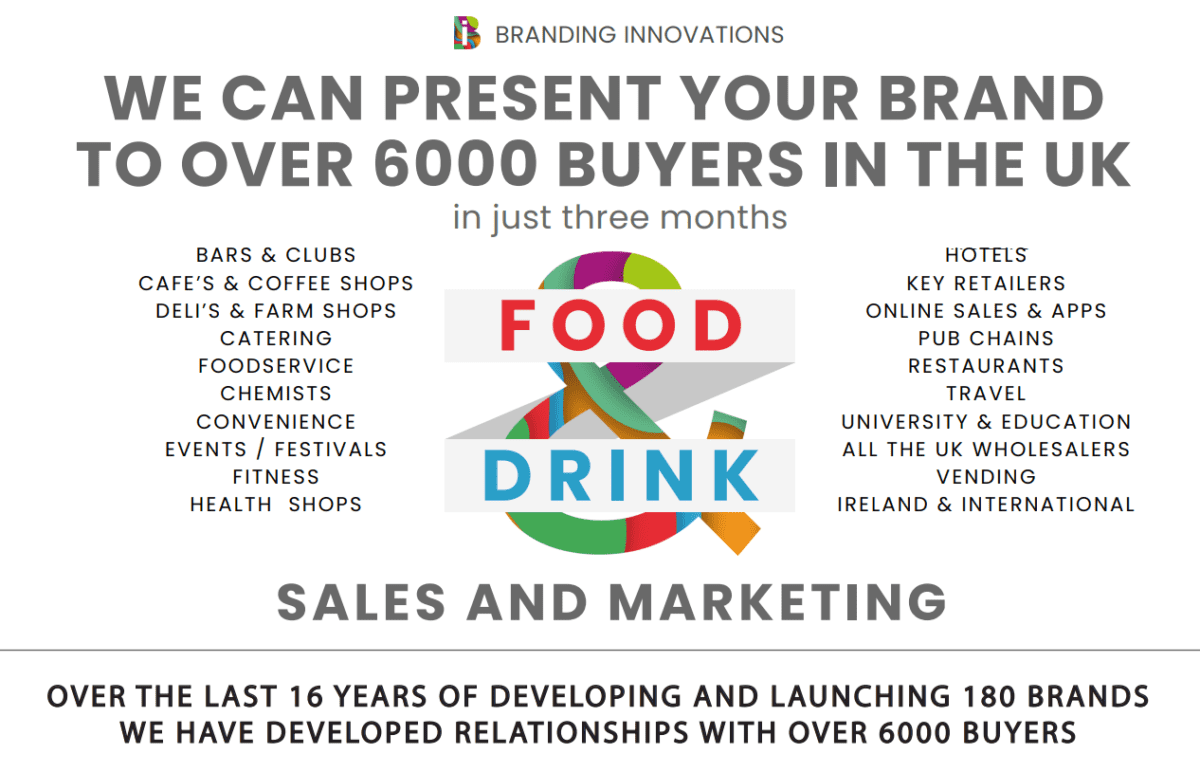
Branding Innovations maintains a database of over 6,500 UK and international buyers covering supermarkets, convenience chains, health stores, gyms, universities, foodservice operators, and online platforms. This direct access is what turned Actiph Water from a concept into simultaneous listings at Tesco, Sainsbury’s, Harrods, and Whole Foods.
UK Drinks Brand Opportunity by Category: The 2026 Landscape
| Category | Market Status | Key Consumer Driver | Entry Difficulty | Opportunity Level |
| Functional Nootropics | Growing fast, underserved | Cognitive performance, stress relief | Medium | Very High |
| Gut Health / Prebiotic Sodas | Early mainstream | Digestive health, clean label | Medium | Very High |
| No and Low Alcohol | Growing strongly | Moderation, wellness lifestyle | Medium-High | High |
| Women’s Wellness | Emerging, underserved | Hormonal balance, mood support | Low-Medium | Very High |
| Clean Energy | Competitive but innovating | Natural caffeine, no crash | Medium-High | High |
| RTD Premium Cocktails | Growing rapidly | Convenience, premiumisation | Medium | High |
| Functional Hydration | Growing | Electrolytes, performance | Medium | High |
| Traditional Energy Drinks | Declining in market share | Stimulation | Very High | Low |
| Standard Kombucha | Saturating | Gut health | Very High | Low |
| Standard Juices | Saturating | Refreshment | Very High | Low |
This table is the single most commercially important piece of data in this article. A drinks brand UK built into a category marked “Low” opportunity is fighting structural headwinds from day one. A brand built into “Very High” opportunity categories is swimming with the tide of the most powerful consumer trends in the UK market.
The Drinks Brands UK Formula: What Every Category Leader Has in Common
Across every category functional, nootropic, no-alcohol, gut health, RTD the UK drinks brands that achieve lasting commercial success share the same five-part formula.
- A verifiable product story. Not a marketing claim. A specific, provable reason the product delivers what it promises. Actiph Water has 400 clinical trials backing ionised water absorption. DIRTEA has certified mushroom extract dosages. The brands that last are the ones that can substantiate every claim on their label.
- A visual identity that earns shelf space. Everything is important down to the meaning of colorways, patterns, and logos. A great brand makes a product influential and adaptable to future trends and clearly communicates to its target audience. The brand’s visual identity must stand out amongst the white noise of the food and drink industry.
- A recipe built for commercial reality. Taste that survives heat treatment, pH adjustment, and twelve months on a shelf without artificial preservation. Ingredients that are compliant, scalable, and cost-effective at production volume. A formula that earns repeat purchase not just a first trial.
- Compliance from day one. No HFSS classification surprises. No Novel Foods stop-notices mid-launch. No allergen recall. Every regulatory box checked before a single unit is produced.
- The right buyer relationships. Not cold emails. Not trade show badge swaps. Direct introductions to the right decision-makers through an agency that has spent 20 years building those relationships.
The Team That Has Built over 200 drinks Brands in the UK and Worldwide
Richard Horwell founded Branding Innovations in 2008 after 35 years in FMCG across the UK, USA, Australia, and the Middle East. He has personally overseen the development and launch of over 200 food and drink brands worldwide.
Dr. Lilla Bessenyei is a qualified chemist specializing in nootropics, adaptogens, superfoods, and functional wellness ingredients. She leads ingredient research, regulatory compliance, and health claims assessment at Branding Innovations, ensuring every brand stands on a product foundation that is scientifically credible, commercially viable, and legally sound.
Claire leads recipe development with 40 years of food science experience. She has taken hundreds of formulations from brief to signed-off, commercially ready recipe across beverages, functional drinks, and food products. Consumers buy for health. They return for taste. Claire’s work is what earns the return.
The agency’s track record includes Actiph Water now listed at Tesco, Sainsbury’s, Harrods, and Whole Foods with $9.8 million raised and export to 15 countries and VitClear, which went from concept to distribution in six months. Both brands demonstrate what a properly built drinks brand UK can achieve when every stage of the process is done correctly from the start.
You can explore the full Branding Innovations service offering here or learn more about the recipe development process that underpins every successful launch.
Frequently Asked Questions
What are the highest-opportunity categories for drinks brands UK in 2026?
The fastest-growing and most underserved categories are functional and nootropic drinks, gut health and prebiotic sodas, no and low-alcohol beverages, women’s wellness drinks, and premium RTD cocktails. These categories align with the most powerful consumer behaviour shifts in the UK market and remain relatively underserved by quality independent brands.
How much does it cost to launch a drinks brand in the UK in 2026?
A realistic minimum investment covering recipe development, branding, first production run, regulatory compliance, and six months of marketing is £50,000 to £100,000. Brands that launch on less than this consistently struggle to reach critical mass before running out of resource. Budget for two years of trading before expecting meaningful profitability.
How do I get my drinks brand listed by a major UK retailer?
Start with premium independent health retailers to build velocity data. Then approach major supermarket buyers with evidence of consumer demand supported by a warm introduction through an established buyer relationship. Branding Innovations’ network of 6,500+ UK buyers provides exactly this access.
What makes a drinks brand stand out in the UK market in 2026?
A specific, verifiable point of difference. A recipe that delivers exceptional taste alongside credible functional benefits. Packaging that communicates the brand proposition in under three seconds. Clean-label ingredients the consumer recognises and trusts. And a route to market built through the right channels to the right buyers.
How does Branding Innovations help build drinks brands in the UK?
Branding Innovations provides complete end-to-end support from market research, recipe development, and regulatory compliance through to brand identity, packaging design, production management, and direct buyer introductions through a network of 6,500+ UK and international contacts.
Build the Drinks Brand the UK Market Is Waiting For
The drinks brands UK that will define the next decade are being built right now. They are being built in categories with genuine growth, on recipes that taste exceptional and deliver on their promises, and with visual identities that earn attention before consumers read a single word. And they are being launched through buyer relationships that open doors no amount of cold outreach can.
The brands being built right now with the right recipe, the right branding, the right regulatory compliance, and the right launch strategy will be the category leaders of the next decade.
At Branding Innovations, the team has done this 180 times. They know what the market rewards. They know what it punishes. And they treat every brand exactly as they would their own.
If you are ready to build a drinks brand that stands out in the UK market, start with a free consultation today. The team takes on only projects with genuine market potential and gives honest feedback from the very first conversation.
Read our Book for Guidance
Branding Innovations is a UK-based food and drink development and branding agency based in London. The team specializes in recipe development, brand strategy, packaging design, production management, and market launch all under one roof. With over 200 brands launched worldwide since 2008, the agency brings real commercial experience to every new project.