
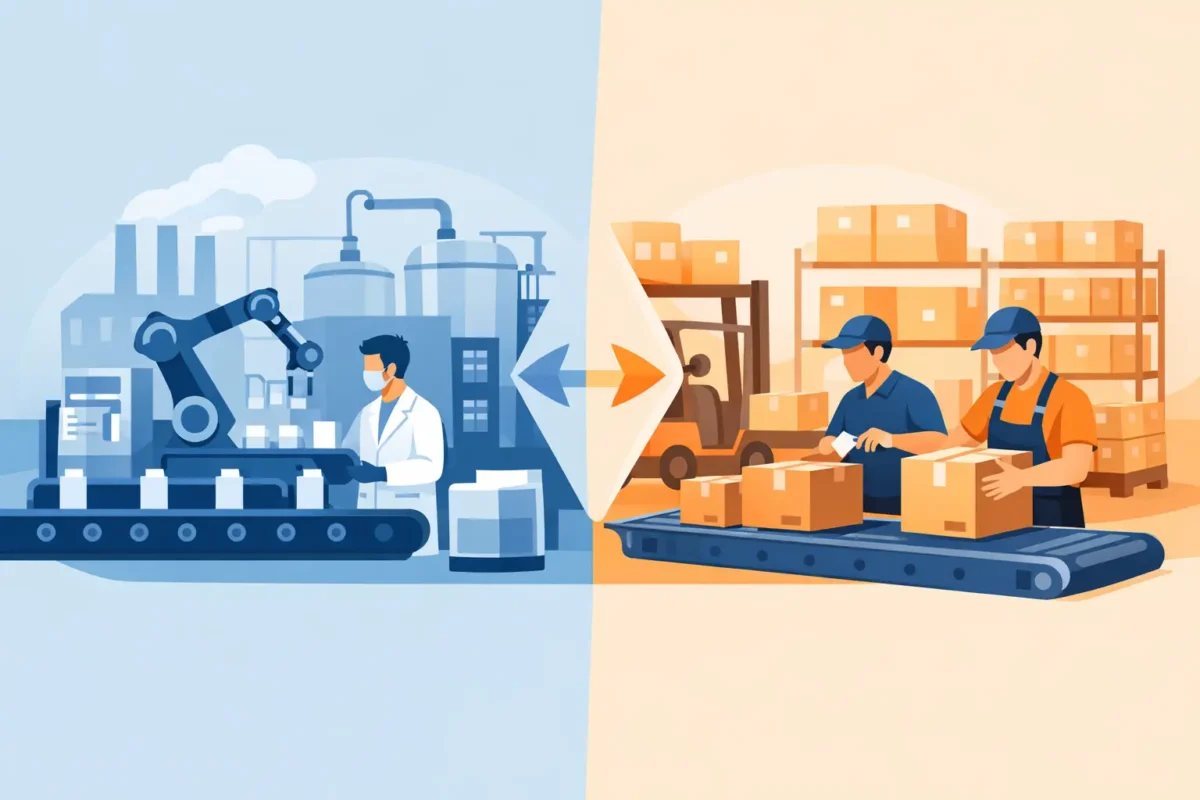
A brilliant drink concept can still fail at the factory gate. In the contract manufacturing vs co packing decision, founders are often comparing quotes before they have defined what they need a production partner to own. That is how margins disappear, timelines slip and a promising launch becomes difficult to scale.
For beverage founders, the choice is not simply about who can put liquid into a can, bottle or pouch. It affects your recipe, intellectual property, minimum order quantities, supply chain exposure, quality standards and ability to respond when a retailer asks for more stock. Get it right early and you build a credible platform for growth. Get it wrong and changing course can be expensive.
Contract manufacturing vs co packing: the real difference
The terms are regularly used interchangeably, and some factories offer both services. That is why you must assess the actual scope of work, not just the label on a supplier’s website.
A co packer usually takes an established product specification and packs it into its final format. You may provide the ingredients, packaging and approved recipe, while the co packer supplies the production line, labour and filling capability. Their core job is to make your finished product accurately, safely and efficiently.
A contract manufacturer generally has a broader remit. They may source ingredients, blend or manufacture the liquid, manage technical specifications, fill the product and sometimes procure packaging too. In effect, they take responsibility for more of the production process under a manufacturing agreement.
Neither option is automatically better. The right model depends on the maturity of your brand, your available cash, the complexity of the beverage and how much operational control you genuinely want to carry.
When co packing makes commercial sense
Co packing can be a strong route for a founder with a finalised recipe, validated ingredients and a clear supply plan. It can also suit brands that want direct control over key materials, especially where a proprietary active ingredient, specialist flavour system or branded packaging is central to the proposition.
The advantage is visibility. You can choose suppliers, negotiate ingredient prices and retain a close grip on the bill of materials. If your product has a distinctive botanical blend or functional wellness formulation, this control may be valuable.
But control has a cost. Somebody must forecast stock, manage supplier lead times, arrange deliveries, check that components arrive in full and resolve problems when they do not. A can supplier running late, a delayed label run or an ingredient that fails specification can stop an entire production slot. The factory may still charge for lost time depending on your agreement.
Co packing is therefore not a shortcut around supply-chain management. It is best suited to founders with enough working capital and operational resource to manage the moving parts properly. It can work extremely well, but it demands discipline.
Questions to ask a co packer
Before committing, establish whether the factory can run your chosen format and process at the volumes you need. A still drink, carbonated beverage, hot-fill product and aseptic functional shot each require different equipment, technical controls and experience.
Ask who is responsible for ingredient and packaging approvals, goods-in checks, batch traceability, quality release and product recall procedures. Confirm the minimum run size, expected line losses, set-up charges, storage fees and the notice required to book production. A low unit price is irrelevant if the minimum order forces you to tie up six months of cash in stock that has a short shelf life.
Most importantly, make sure your formula and specification are genuinely ready for scale. A kitchen recipe is not a factory-ready recipe. Processing can change flavour, colour, texture, carbonation and the stability of functional ingredients. Without proper trials, the first full run is an expensive place to learn that lesson.
When contract manufacturing is the smarter route
Contract manufacturing is often the better choice when a brand needs help turning an idea or early prototype into a repeatable commercial product. The manufacturer may support sourcing, blending, processing, filling and technical documentation, reducing the number of suppliers you need to manage.
For first-time founders, this can remove a substantial operational burden. Rather than coordinating ingredients from one company, cans from another, labels from a third and production with a fourth, you have a more integrated manufacturing route. That can speed up development and reduce the risk of components not matching factory requirements.
It is particularly useful for complex drinks. Functional beverages may need careful consideration around active dosage, flavour masking, sedimentation, shelf-life performance and permitted claims. A contract manufacturer with relevant category experience can help ensure the product is manufacturable, stable and commercially viable, not merely attractive in a presentation.
The trade-off is reduced direct control over the supply base and, in some cases, less transparency over individual component costs. You also need to look closely at ownership. If a manufacturer develops or adapts your formula, your agreement must clearly state who owns the intellectual property, who holds the final specification and what happens if you move production later.
A serious contract manufacturing partner should be able to explain exactly what is included: development support, ingredient sourcing, packaging procurement, production, warehousing, testing and technical compliance. Do not assume these services sit inside one quoted unit price.
The decision is bigger than unit cost
Founders understandably focus on cost per can or bottle. Retail margins are tight, distributors need room to earn and promotional activity can quickly erode profit. Yet selecting a production model on the cheapest quote alone is a classic early-stage mistake.
A more useful comparison looks at total landed cost and operational risk. Include development fees, minimum order quantities, ingredient deposits, packaging stock, freight, storage, wastage, testing, payment terms and the working capital locked into each run. Then test the model against your sales plan rather than your ambition.
If your first 5,000 units will take nine months to sell, a production partner requiring 50,000 units may not be a sign that you are ready to scale. It may be a signal to reconsider the format, route to market or launch strategy. Equally, choosing a very small run at a high unit cost can make it impossible to build a sustainable retail business.
The best answer may change as the brand grows. A founder may start with a contract manufacturing partner to develop, validate and launch the product, then move towards a co-packing model once volumes justify direct procurement and an internal operations capability. Others will stay with contract manufacturing because speed and simplicity are worth more than marginal savings.
What beverage founders must protect
Whether you choose contract manufacturing or co packing, the agreement matters as much as the relationship. Friendly conversations and verbal assurances are not enough when you are committing serious cash to stock.
Your contract should address recipe ownership, confidentiality, quality standards, accepted tolerances, liability, insurance, recalls, rejected batches, lead times, payment terms and termination rights. It should also set out what happens to your ingredients, printed packaging and finished stock if the relationship ends.
Do not overlook shelf life and product claims. A functional drink positioned around energy, gut health, hydration or wellness needs evidence-led claims and compliant labelling. The same applies to allergen controls, nutritional information, deposit return requirements where relevant, barcodes and packaging specifications. These are commercial fundamentals, not last-minute admin.
You should also assess capacity honestly. Can the factory support your launch volume and your potential growth? Are you one small customer among major national brands, likely to lose production slots during peak periods? Is there contingency if a critical line goes down? A capable partner will answer directly rather than promising capacity they cannot protect.
Choose the partner that fits your stage
The strongest manufacturing choice is the one that matches the stage your business is actually at. If you have a proven recipe, supply-chain capability and appetite for detailed control, co packing may give you flexibility and purchasing power. If you need technical support, a scalable formulation and fewer operational headaches, contract manufacturing may give you the better chance of a controlled launch.
At Branding Innovations, we see the same pattern repeatedly: the brands that progress fastest are not those that chase the lowest quote. They are the ones that build the product, commercial model and manufacturing route together from the start.
Before you send another enquiry, write down what you need to own, what you can afford to manage and what volume your sales plan can realistically support. That clarity will make the right factory far easier to identify – and far harder to outgrow.