
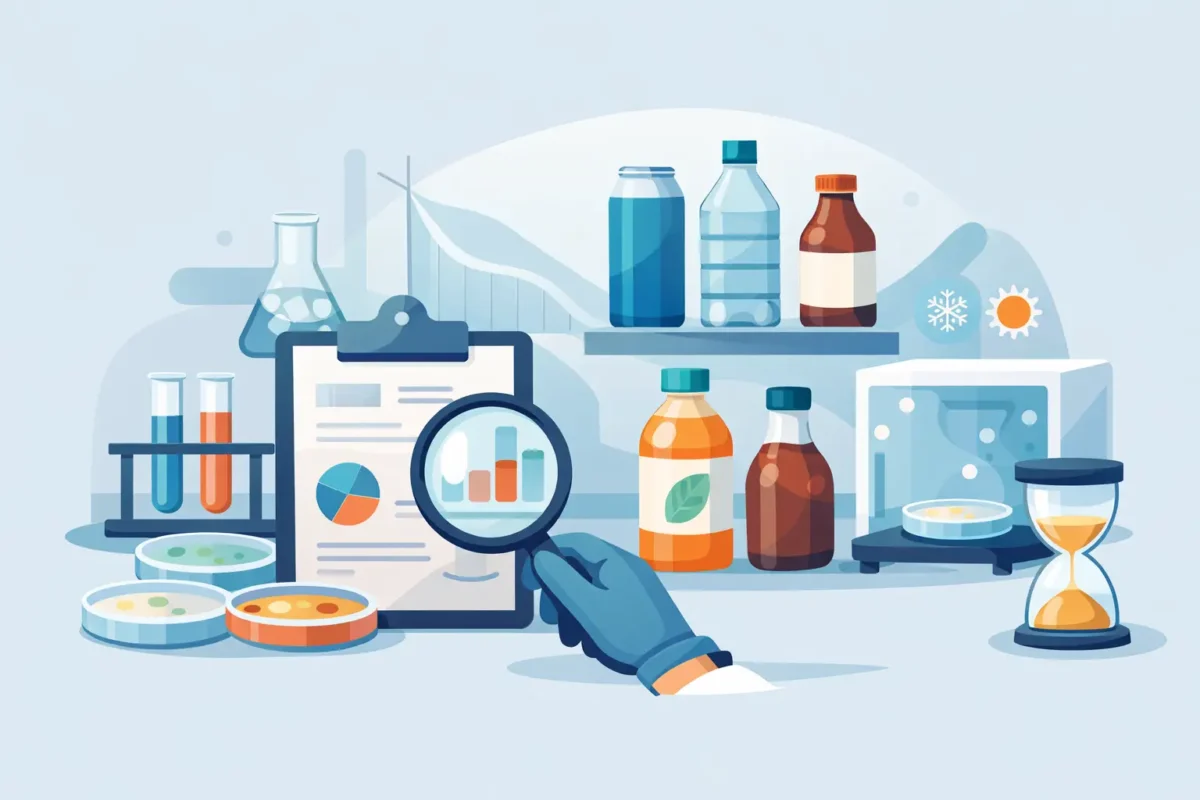
A drink can taste spot on in the development kitchen and still fail six weeks later in a warehouse. That is why shelf life testing for drinks matters so much. If you are serious about building a beverage brand that can survive retail, wholesale and scale, you need evidence that your product stays safe, stable and commercially acceptable for the full life you plan to print on pack.
Too many founders treat shelf life as a technical box-tick near the end of the process. It is not. It affects formulation, packaging, manufacturing method, storage conditions, logistics, retailer confidence and ultimately repeat purchase. Get it wrong and you are not just dealing with a quality issue. You are dealing with wasted stock, rejected listings, damaged brand trust and expensive reformulation.
What shelf life testing for drinks actually proves
At a basic level, shelf life testing tells you how long a drink remains safe to consume and how long it remains good enough to sell. Those are not always the same thing.
A product may still be microbiologically safe while showing flavour fade, colour shift, ingredient settling, carbonation loss or vitamin degradation that makes it commercially weak. For a founder, that distinction matters. Retailers and consumers do not reward technical safety if the product tastes tired or looks unstable halfway through its stated life.
This is why shelf life testing usually looks at three areas together: microbiological safety, chemical and physical stability, and sensory quality. In practice, the right approach depends on the drink. A still juice blend, a functional wellness shot, a dairy-based beverage and a carbonated soft drink all behave differently over time. Anyone promising a one-size-fits-all answer is oversimplifying the job.
Why founders get caught out
Early-stage brands often make one of two mistakes. The first is assuming refrigerated equals low risk. It does not. Chilled drinks can still suffer from yeast, mould, flavour drift and texture changes. The second is relying on a recipe that worked at bench scale without testing how it performs once it has been hot filled, pasteurised, tunnel processed or produced at manufacturing scale.
Shelf life is not created by hope. It is built into the product through formulation decisions, process controls and packaging choices. pH, sugar content, preservatives, oxygen pickup, filling temperature, headspace, closure integrity and even light exposure can change the outcome.
This is where commercial realism matters. There is no point designing a drink with a dream 12-month shelf life if the flavour profile collapses after four months. Equally, there is no point launching with a cautious eight-week life if the product could confidently achieve six months and open up better distribution options. Shelf life influences your route to market more than many founders realise.
How shelf life testing for drinks is usually carried out
In most cases, testing starts with a clear shelf life target based on the product concept and sales model. If you want ambient distribution through wholesale and retail, your evidence needs to support that. If the product is chilled and sold through direct channels with faster rotation, the testing strategy may be different.
Real-time testing is the backbone. Samples are stored under defined conditions and assessed at planned intervals across the intended life of the product. That might include microbiological testing, pH checks, brix, carbonation, viscosity, active ingredient retention, packaging integrity and sensory review. Real-time testing gives the most reliable picture because it mirrors what actually happens over time.
Accelerated testing can also be useful, especially during development, but it has limits. By exposing products to higher temperatures or stressed conditions, you can get an early read on likely degradation patterns. That can help identify weak points quickly. But accelerated results do not always translate neatly into a final shelf life claim, particularly for products with complex flavours, natural colours, live ingredients or sensitive functional actives.
Challenge testing may be required in some cases, particularly where microbiological risk needs to be better understood. This involves introducing specific organisms under controlled conditions to assess whether the product and process can control them. Not every drink needs the same level of challenge work, but high-risk assumptions are dangerous territory.
The factors that most often shorten drink shelf life
Founders usually focus on one issue, such as preservation, when the real answer sits across the whole system. The common pressure points are fairly predictable.
Low acid products carry greater microbiological risk than high acid ones. Natural ingredients can introduce instability, especially where there are particulates, proteins, botanicals or fresh-style flavour notes. Functional ingredients may lose potency over time, which matters if the health positioning is central to the brand. Packaging can also work against you. Clear bottles may look great on shelf but leave light-sensitive ingredients exposed. Closures and seals can compromise carbonation or allow oxygen ingress.
Then there is process. A brilliant formulation can still fail if the manufacturing method is inconsistent or not suited to the product. Small changes in fill temperature, hold time or hygiene discipline can alter shelf life dramatically. This is one reason why founder-led drinks need proper scale-up support rather than kitchen logic carried into commercial production.
Shelf life is a commercial decision as much as a technical one
This is the part many people miss. Your target shelf life should match your route to market.
If you are pitching major retail, distributors and export partners, a short life can become a barrier unless the category naturally supports it. Buyers need enough life for warehousing, transport, shelf placement and consumer use. If your product only has a narrow viable window, the supply chain becomes harder and waste risk climbs.
On the other hand, chasing a longer shelf life can force compromises. You may need a different process, a different pack format or a formula adjustment that changes taste, mouthfeel or cost of goods. There is always a trade-off. The right answer is not the longest life possible. It is the shelf life that gives your brand the best chance of success without undermining quality or margin.
That is why shelf life should be discussed early, alongside branding, pack format, manufacturing and pricing. It is not a final technical add-on. It shapes the commercial model.
What founders should prepare before testing starts
Good shelf life work depends on good inputs. You need a stable recipe candidate, clarity on intended processing, final or near-final packaging, and a realistic understanding of where the product will be sold and stored. Testing a provisional sample in the wrong bottle with the wrong closure gives you data, but not the data you need.
You also need to be honest about your claims. If the drink is built around vitamins, minerals, botanicals, protein or probiotic positioning, shelf life is not just about whether the liquid stays drinkable. It is also about whether the claimed benefit still stands at the end of life. That has obvious regulatory and brand implications.
For ambitious founders, this is where working with an experienced beverage development team pays off. At Branding Innovations, we see shelf life as part of the wider path to launch, not an isolated lab exercise. The formulation, process, packaging and route-to-market decisions need to work together, otherwise you are solving one problem while creating three more.
Common mistakes that cost brands time and money
The expensive errors are usually avoidable. Printing an optimistic best-before date before the data is ready is one. Switching ingredients or packaging after testing is another, because even small changes can invalidate your results. Leaving sensory review out of the process is also a mistake. A technically stable drink that no longer tastes fresh enough will still disappoint customers.
Another common issue is underestimating storage reality. Products are not always kept in ideal conditions. They sit in warm stockrooms, travel through mixed distribution chains and spend time under retail lighting. Your testing plan should reflect that reality, not a perfect laboratory fantasy.
And finally, do not confuse anecdotal confidence with evidence. Saying a similar product on the market has a 12-month life means very little unless your formulation, process and packaging are genuinely comparable.
The right question is not just “how long will it last?”
A better question is this: what shelf life does this drink need to win commercially, and what must be true in formulation, process and packaging to support it?
That changes the conversation. It moves you away from passive testing and into active product strategy. You stop hoping the drink will survive and start engineering a product that is built for its sales channel.
Founders who take shelf life seriously usually make better decisions across the board. They choose formats more wisely, brief manufacturers more clearly and go to buyers with stronger evidence. That confidence shows.
If you are building a drink brand for proper scale, shelf life is not the dull technical bit at the end. It is one of the clearest signals that you are creating a real FMCG product rather than just a promising idea.