
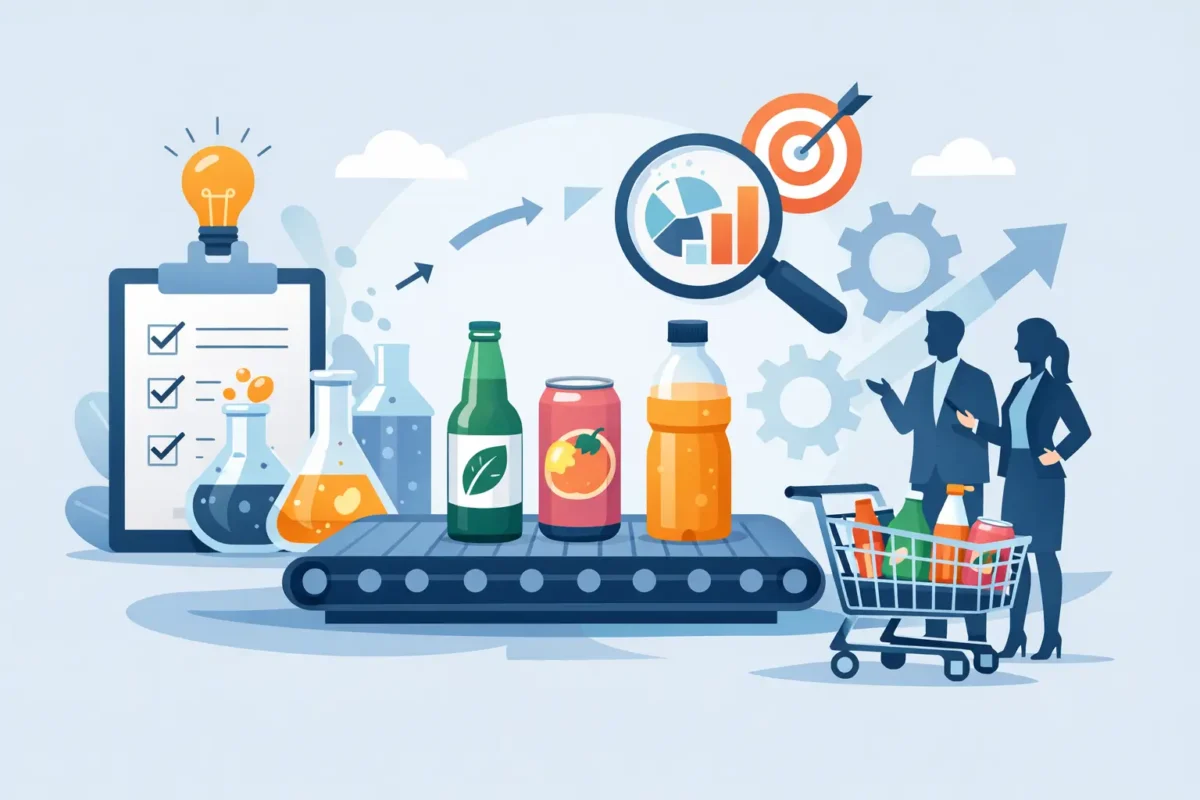
A lot of drinks fail long before they reach a shelf. Not because the founder lacks ambition, but because the beverage innovation process was built around the idea alone and not the commercial reality around it. In FMCG, a drink has to do more than sound exciting. It has to taste right, cost out properly, survive production, make sense on pack, comply with regulation and give buyers a reason to list it.
That is where founders often get caught out. They focus on the concept, maybe even the flavour, and assume the rest can be fixed later. It usually cannot. The strongest drinks brands are built through a process that tests the product, the proposition and the route to market at the same time.
What the beverage innovation process really involves
A serious beverage innovation process is not just recipe development with a few mood boards added on top. It is a commercial build from day one. You are shaping the liquid, the brand, the manufacturing plan and the sales story together, because each decision affects the next.
Change an ingredient and your cost of goods may move. Change the pack format and your filling options may narrow. Position a drink as functional wellness and suddenly substantiation, claims and compliance become critical. Push for a premium feel and your branding, price point and target retailer all need to line up.
This is why shortcuts are expensive. If you treat formulation, packaging and go-to-market as separate jobs, you often end up reworking all three. Founders lose time, burn budget and still arrive at a product that is harder to sell than it should be.
Start with the commercial gap, not just the product idea
The best drinks do not begin with, “I fancy launching a mango drink.” They begin with a sharper question. What gap exists in the market, who is buying into it, and why would they switch from what they already drink?
That sounds obvious, but this is where realism matters. A category can be growing and still be overcrowded. Functional wellness can be full of opportunity and full of copycat claims at the same time. Energy, hydration, nootropics, gut health and low sugar all have demand, but demand alone is not a strategy.
At this stage, you need to pressure test the concept against actual market conditions. That means looking at target consumer, price architecture, retailer fit, competitor saturation and the strength of your point of difference. Sometimes the answer is to refine the proposition. Sometimes it is to change the format, the flavour direction or even the whole audience.
Founders do not always love hearing that. But honesty here is cheaper than optimism later.
A good concept needs a clear reason to exist
If your drink cannot be explained quickly, it will struggle. Buyers do not have time for vague positioning, and consumers do not reward confusion. Your concept should answer three things fast: what it is, who it is for and why it is better or more relevant than the alternatives.
That does not mean reducing everything to a gimmick. It means building a proposition with enough clarity to survive real commercial scrutiny.
Formula first, but never in isolation
Once the concept is validated, the liquid has to prove itself. This is where many founders discover the gap between kitchen thinking and market-ready formulation. A flavour that works in a small trial may not behave the same way at scale. A functional ingredient that sounds impressive on paper may create bitterness, instability, sedimentation or shelf-life issues.
Taste still wins. Health positioning matters, but if the drink is not enjoyable, repeat purchase suffers. That is especially true in functional categories where founders sometimes overload the recipe in pursuit of stronger claims. More is not always better. There is a line where the formulation becomes harder to drink, harder to manufacture and harder to price.
The right approach is iterative. You test flavour profile, sweetness balance, mouthfeel, ingredient interaction, stability and cost together. You do not chase a technically clever formula that nobody wants to finish.
The trade-off founders need to understand
There is nearly always a trade-off somewhere. Cleaner label versus shelf life. Higher active dosage versus taste. Premium ingredients versus target margin. Convenience versus sustainability. The job is not pretending those tensions do not exist. The job is deciding which trade-offs support the brand and which ones damage it.
That is where experienced beverage development becomes valuable. It stops you falling in love with a formula that cannot survive contact with manufacturing or retail.
Branding should sharpen the sale, not decorate the pack
A strong drink brand does not just look good. It makes the product easier to understand, easier to remember and easier to buy. In the beverage innovation process, branding is not the finishing touch. It is part of the commercial engine.
Your name, pack design, claims hierarchy, messaging and visual identity all need to reflect the product truth and the audience expectation. If you are targeting wellness-led consumers, the branding needs credibility without becoming clinical. If you are targeting mainstream convenience, it needs speed and clarity. If you are launching at a premium price, the look and language have to justify that premium in seconds.
This is where many early-stage brands go wrong. They build packaging for themselves, not for the shelf. They over-explain. They clutter. They copy category cues too closely and lose distinction, or go so far into creativity that nobody can tell what the product is.
Good branding balances standout and clarity. You need both.
Manufacturing is where great concepts get tested properly
A drink is not launch-ready because the sample tastes good in a development session. It is launch-ready when it can be produced consistently, compliantly and profitably.
That means choosing the right manufacturing route, understanding minimum order quantities, checking ingredient supply, validating process compatibility and making sure your packaging works in the real world. A can, bottle or sachet choice is not just aesthetic. It affects logistics, filling lines, storage, cost and buyer perception.
The wrong manufacturing decision can trap a founder quickly. You can end up with a product that is too expensive to scale, too complex to source or too awkward for your intended channel. This is why route-to-market thinking needs to be present before production decisions are finalised.
Scale changes the conversation
Small-batch success does not guarantee scalable success. Some ingredients become harder to source at volume. Some recipes become less stable. Some unit economics only work when volumes rise, and getting to those volumes is the hard part.
This is where a connected development model matters. If your innovation partner understands formulation, brand positioning and manufacturing access together, you avoid making isolated choices that create downstream problems.
The launch plan should shape the product before launch
Too many founders build the drink and only then ask how to sell it. That is backwards. Distribution strategy, buyer fit and launch channel should influence development much earlier.
A product built for online direct-to-consumer behaves differently from one designed for grocery, foodservice or wholesale. Pack size, case configuration, margin expectations, messaging and repeat purchase drivers all shift depending on where the drink will gain traction first.
Retailers and distributors are not looking for nice ideas. They are looking for products with a credible reason to exist and a founder who understands the commercial maths. Can it sell through? Is the category story clear? Does the margin stack up? Is the branding strong enough? Will consumers come back for it?
That is why the beverage innovation process has to produce more than a finished liquid. It has to produce a convincing business case.
Why founders need an integrated process
If you are building a beverage brand seriously, splitting research, formulation, design, manufacturing and launch support across disconnected suppliers usually creates friction. Advice clashes. Timelines slip. Responsibility gets blurred. And when something goes wrong, everyone points elsewhere.
An integrated process gives founders a much better chance of success because the product is being built as a whole commercial proposition, not a series of separate tasks. That is the thinking behind Branding Innovations. The goal is not just to help someone make a drink. It is to help them build a launch-ready brand with the technical credibility, commercial structure and buyer relevance to compete properly.
That is a different standard. It is also the standard the market now expects.
Beverage innovation process mistakes that cost founders most
The biggest mistakes are usually not dramatic. They are small assumptions that compound. Overestimating demand. Underestimating cost. Treating branding like decoration. Ignoring compliance until late. Choosing ingredients before understanding manufacturing limitations. Building for everyone and therefore for no one.
The common thread is lack of alignment. When the product, pack, proposition and route to market are not working towards the same goal, the brand gets weaker at every stage.
Getting this right does not mean removing all risk. Drinks remain a competitive category, and there are no guarantees. But there is a huge difference between taking market risk with a smart, disciplined proposition and taking avoidable risk because the process was not strong enough.
For ambitious founders, that is the real point. A good idea can get attention. A well-run process gives it a fighting chance of becoming a real brand people buy again.