
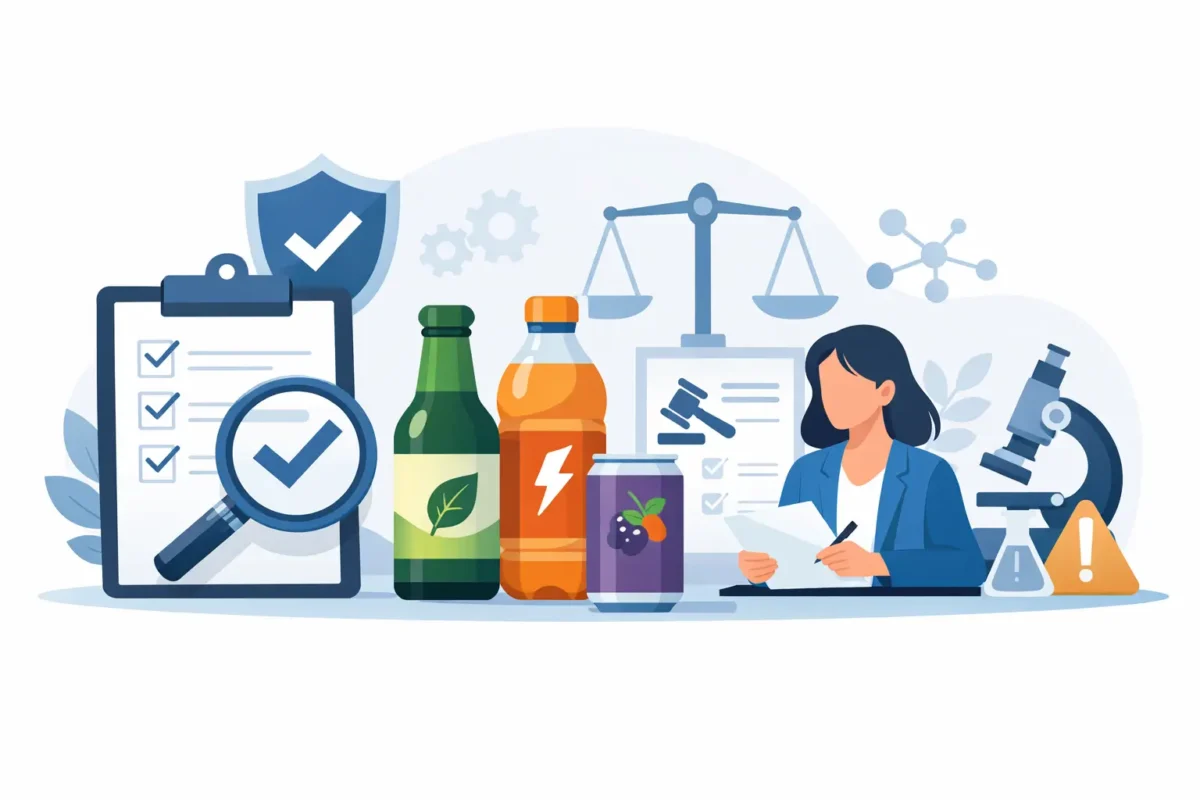
You can spend months perfecting a functional beverage, nail the flavour, secure a manufacturer and build packaging that looks ready for shelf – then lose momentum because your claims, label copy or ingredient decisions do not hold up. That is why a functional drinks compliance guide matters early, not just when you are about to print cans.
For founders entering the UK drinks market, compliance is not a legal box-tick. It shapes product development, brand positioning, packaging, retailer conversations and your ability to scale without expensive rework. Get it right from the start and you protect margin, credibility and launch speed. Get it wrong and you can end up reformulating, redesigning and re-educating buyers when you should be selling.
Why compliance needs to sit at concept stage
A lot of early-stage founders treat compliance as the final check before launch. Commercially, that is the wrong order. In functional drinks, the compliance position affects what you can say, how strongly you can say it, what actives you can include, what dosage levels make sense and whether your product is likely to trigger scrutiny from retailers or enforcement authorities.
If your concept relies on language such as boosting immunity, improving focus, supporting gut health or reducing stress, you need to know what is actually defensible. There is a big difference between a product that contains functional ingredients and a product that can legally communicate meaningful benefits on pack.
That gap catches out a lot of ambitious brands. The formulation team may be working towards efficacy. The brand team may be building a strong wellness story. But if the final wording is not compliant, one side of the business is going to lose ground. Serious founders deal with that tension upfront.
The functional drinks compliance guide: what is really at stake
In simple terms, compliance in this category sits across ingredients, claims, labelling, packaging presentation and product classification. Those areas overlap more than many founders expect.
A label is not just a design exercise. Every word on pack can change your risk profile. A hero ingredient can be acceptable, but the way you describe its effect may not be. A product can be technically safe, but if the communication implies medicinal benefit, you may create a different regulatory problem altogether.
This is where commercial realism matters. The strongest functional drinks are not always the ones with the boldest promises. They are the ones built to survive scrutiny while still giving consumers a clear reason to buy.
Claims are where most brands get exposed
The biggest trap in the category is assuming that consumer-friendly benefit language is automatically allowed. It is not. Functional drinks live in a space where marketing ambition often outruns regulatory reality.
If you want to reference energy, cognition, hydration, immunity, digestion or relaxation, the exact wording matters. So does the ingredient basis behind it. Some claims are tightly controlled. Some require specific nutrient thresholds. Others may be allowed in one format but become problematic when paired with broader lifestyle language, testimonials or visual cues.
Even when a claim looks mild, context matters. “Supports focus” may sound softer than “improves concentration”, but that does not mean it is compliant by default. The full label story, ingredient profile and overall presentation all need to line up.
This is why founders should stop asking, “Can we get away with it?” and start asking, “Can we defend it under scrutiny?” Retailers, distributors and manufacturing partners are far more comfortable with brands that have done that homework.
Functional ingredients do not guarantee functional claims
This is another hard truth. Adding botanicals, nootropics, adaptogens, vitamins or minerals does not automatically give you freedom to make broad health statements. The commercial appeal of an ingredient and the legal basis for a claim are not the same thing.
That matters at formulation stage. Sometimes a founder chooses an ingredient because it is trending, but the dosage required for meaningful efficacy creates cost, flavour or stability issues. In other cases, the ingredient can stay in the formula, but the brand has to be more disciplined in how the benefit is communicated.
Neither outcome is a disaster. But both are easier to manage before you commit to your final proposition.
Labelling errors are expensive because they hit late
Most compliance mistakes become painful when packaging is already moving towards print. By that point, you are no longer debating theory. You are burning time, agency costs and production deadlines.
A compliant label needs more than a clean ingredient list. Product name, net quantity, ingredients, allergens where relevant, nutrition information, storage instructions, business operator details, usage instructions and any mandatory warnings all need to be handled correctly. Depending on the formula and positioning, there may be extra considerations around caffeine statements, sweeteners or active ingredients.
Then there is the front of pack. Founders often focus on what must legally appear, but what drives risk is frequently the promotional language, iconography and hierarchy of information. If the front of pack sells a health promise that the technical file cannot support, the problem is already baked in.
Classification can change the whole route to market
One of the most commercially significant issues is product classification. Is your product clearly a soft drink or food supplement format, or are you drifting into territory that changes regulatory expectations? That distinction matters because it influences formulation choices, labelling approach, serving guidance and how buyers perceive the product.
This is where founders need blunt advice, not guesswork. A concept that sounds exciting on paper can become harder to launch if the classification route creates friction with mainstream retail or demands a level of substantiation the business is not ready for.
Sometimes the smartest move is to simplify the proposition, tighten the functional story and launch with a cleaner, more scalable position. That is not playing small. It is building a brand that can actually get listed and grow.
A practical way to de-risk compliance before launch
The best compliance process is not reactive. It should run alongside development. That means pressure-testing the concept, formula, claims and packaging together rather than in isolation.
Start with the proposition. Be clear on the single strongest consumer promise behind the drink. Then test whether that promise can be supported legally, not just creatively. If the answer is unclear, adjust before your brand identity and pack copy become dependent on it.
Next, review the formula with both function and communication in mind. Are your hero ingredients there for efficacy, marketability or both? Are dosage levels commercially viable? Is there a cleaner route to a compliant claim through different nutrients or positioning? This is where technical and brand thinking need to work together.
After that, build the label from a compliance-first draft, not from finished design copy. It is far easier to make strong branding work within a compliant framework than to rescue a beautiful label that was built on risky wording.
Finally, sense-check how the product will be viewed by retailers and partners. A brand may be legally tidier than a competitor, but if the proposition still feels confusing or overclaimed, buyers will hesitate. Compliance and commercial clarity need to reinforce each other.
The founder mistakes that slow launches down
The first mistake is leaving compliance too late. The second is assuming your designer, manufacturer or ingredient supplier is covering it for you. They may contribute useful information, but that does not mean they are owning the full picture.
The third mistake is building a brand around claims that are unlikely to survive scrutiny. Founders get emotionally attached to a message because it sounds powerful, not because it is viable. When that message gets stripped out, the whole proposition weakens.
The fourth is chasing every trend at once. Energy, nootropics, gut support, adaptogens, clean label, low sugar and premium taste can all sound attractive, but stacking too many functional cues increases complexity fast. A tighter proposition is usually easier to formulate, easier to communicate and easier to defend.
What serious founders do differently
They treat compliance as part of product strategy, not a final legal review. They understand that every decision on actives, dosage, flavour system, sweetening approach and on-pack wording affects launch readiness. They also accept that the strongest commercial route is not always the most aggressive one.
That is where an experienced beverage development partner earns its keep. A team that understands formulation, branding and route to market can spot conflicts early, before they become sunk cost. At Branding Innovations, that joined-up thinking is exactly what gives founders a better chance of getting from idea to shelf without the usual chaos.
The real win is not producing the boldest pack in the category. It is building a functional drink that tastes right, says the right thing, clears the right checks and gives buyers confidence from day one.
If you are building in this space, be ambitious – but be precise. The founders who move fastest are usually the ones who stop treating compliance as a brake and start using it as a filter for better decisions.