
Your Idea Deserves More Than Guesswork
Every successful food and drink brand started with an idea. Most ideas that never become brands share one thing in common: the founder tried to bring them to market without a specialist product development agency behind them.
In 2026, the UK food and drink market demands more than a great recipe, a good name, and enthusiasm. It demands commercial rigour, regulatory precision, professional formulation, and buyer relationships built over years. Without these, even the most original idea stalls before it ever earns its first repeat purchase.
The food industry is highly saturated and competitive, with countless brands offering similar products. Differentiation is crucial for standing out. New product development allows brands to offer something different — whether it is a novel flavour combination, ingredients that showcase sustainability, a product with added nutritional benefits, or a product emphasising local provenance.
Branding Innovations is the UK’s leading full-service product development agency for food and drink brands, combining market research, recipe development, regulatory compliance, brand identity, production management, and buyer introductions under one roof. This article explains exactly what that process looks like, why it matters, and how it turns promising ideas into products that lead their category.
The UK Product Development Landscape in 2026
Understanding the market a new product enters is the starting point of every intelligent development decision.
The global food and beverages market is expected to reach $7.41 trillion in 2026, growing at a CAGR of 5.2%. Premium, specialty, and healthier food and drink options are driving the strongest growth, as consumers spend more intentionally and scrutinise ingredient quality more closely than ever before.
For food and drink manufacturers, new product development offers the opportunity to address shifting consumer demands. By continuously developing products that cater to health, wellness, and sustainability trends, brands stay competitive and meet the evolving expectations of their target market. Without innovation, food businesses risk becoming outdated and losing consumer trust, which has a long-lasting impact on sales and brand loyalty.
In 2026, the biggest food and drink trends include fermentation innovation, plant-based alternatives gaining mainstream traction, and flavour innovation stretching across categories in unexpected ways. Brands that identify these movements early and build products into them consistently outperform those chasing existing categories.
The opportunity is real. But the path from idea to shelf is more demanding than most founders anticipate. A product development agency that has navigated this path over 180 times knows exactly where the risks are and how to avoid them.
What a Product Development Agency Does: The Full Scope
Most founders assume a product development agency handles recipe formulation and little else. In practice, genuine end-to-end product development covers every stage of the journey from concept to commercial launch.
| Stage | What It Involves | Why It Cannot Be Skipped |
| Market Research | Gap analysis, consumer profiling, and global trend mapping | Prevents building a product that the market already has |
| Concept Development | Positioning, USP definition, flavour direction | Shapes every commercial decision that follows |
| Recipe Development | Formulation, ingredient sourcing, shelf life, scale testing | Ensures the product survives commercial production |
| Regulatory Compliance | Novel Foods, allergens, health claims, HFSS, nutritional labelling | Prevents legal disasters after production is committed |
| Brand Development | Naming, visual identity, packaging design | Determines whether consumers pick it up or walk past |
| Production Management | Co-packer sourcing, supply chain, quality control | Ensures consistent, certified, commercially viable manufacture |
| Launch Strategy | Channel selection, buyer introductions, and marketing plan | Gets the right product to the right buyer at the right time |
Every stage connects to the next. A decision made in stage one shapes what is possible in stage seven. A shortcut in stage three creates a crisis in stage five. This is why a product development agency that manages all stages under one roof — with one integrated brief — consistently produces better commercial outcomes than a fragmented collection of separate suppliers.
Why Most Product Ideas Never Reach the Shelf
Understanding why ideas fail is as important as knowing how to make them succeed. Here are the patterns Branding Innovations sees repeatedly.
Building the Product Before the Market
The most common and most expensive mistake. A founder perfects a recipe they love and then searches for a market to sell it into. The professional approach is the reverse: identify the market gap first, then develop the product to fill it precisely.
Identify market gaps through brainstorming, trend analysis, and consumer insights. Perform SWOT analysis and market research to uncover unmet needs — for instance, beverages with probiotics or snacks that are plant-based. Clearly describe the unique selling proposition of the product, identify the target audience, and create the concept to meet specific needs and preferences.
A product development agency that starts with market research rather than a recipe brief builds products the market is already looking for.
Underinvesting in Recipe Development
A kitchen recipe rarely survives the transition to commercial production without significant reformulation. Heat treatment, pH management, ingredient interaction, and shelf life requirements all change dramatically at an industrial scale. A product that tastes perfect in a domestic kitchen can taste completely different after pasteurisation, after six months on a shelf, or after ten production batches at a co-packer.
At Branding Innovations, only products that are natural, innovative, and genuinely great-tasting are developed. Being in business for many years means the team knows what sells in today’s market — and ensures every recipe supplies demand for years to come through research into future taste trends.
Ignoring Compliance Until It Is Too Late
This is the mistake that turns a promising brand into an abandoned investment. A Novel Foods issue discovered after production is committed means a product that cannot legally be sold. An unapproved health claim printed on 10,000 units triggers a recall before the first case reaches a retailer. An incorrect allergen declaration creates a product safety risk that destroys a brand overnight.
Compliance review must run in parallel with recipe development — not follow it.
Approaching the Wrong Buyers at the Wrong Time
Major supermarket buyers require velocity data — evidence that real consumers are already buying the product at meaningful rates. Approaching Tesco or Sainsbury’s without this data produces a rejection that closes that buyer relationship for 12 to 18 months. The right launch channel builds the evidence that opens the right doors at the right time.
The Branding Innovations Product Development Process: Stage by Stage
Stage 1 — Market Research and Gap Validation
Every project at Branding Innovations begins with structured market analysis — not with a recipe brief. The team researches the UK market and examines global trends to identify what is growing, what is saturating, and where the genuine white space sits.
Branding Innovations introduces flavour pairings that fill researched gaps in the market and complement the chosen ingredients. A detailed brief is curated for the recipe developer based on this research — establishing what flavours to work with, what trends to respond to, and what the target audience expects before a single ingredient is tested.
This research validates the commercial opportunity before any development investment is committed. It also identifies the global trend pipeline — because a trend entering the US market today typically arrives in UK retail within 12 to 24 months. Brands built into that trajectory before the domestic market saturates consistently outperform those chasing existing categories.
Stage 2 — Concept Definition and Positioning
With the market gap validated, the product concept is defined precisely. This stage establishes the single, specific, credible reason a consumer should choose this product over everything else available to them at the point of sale.
The positioning brief answers four questions before development advances. Who exactly is this product for? What one outcome does it deliver? Why should the consumer trust the formula? What does it communicate in under three seconds on a retail shelf?
Every subsequent decision — recipe, name, visual identity, packaging, pricing, channel strategy — flows from this document. A weak positioning brief produces a weak product with nowhere clear to go.
Stage 3 — Recipe Development
Claire, the lead recipe developer at Branding Innovations, brings 40 years of food science experience to every formulation brief.
The recipe developer creates samples and ships them directly to clients or reviews them with the team. The team refines the product until the flavour reaches final approval. The team also checks all selected ingredients against Novel Foods requirements to ensure eligibility within the UK market before production begins.
The development process includes multiple formulation rounds covering concentration, temperature, processing methods, packaging interaction, and shelf-life performance. The team does not approve the recipe until it satisfies both the functional brief and exceptional taste standards simultaneously. Consumers may purchase products for health benefits, but they return because of taste.
Stage 4 — Regulatory and Compliance Review
Dr. Lilla Bessenyei, a qualified chemist specialising in nootropics, adaptogens, superfoods, and functional wellness ingredients, leads all compliance work at Branding Innovations.
Every ingredient is assessed against Novel Foods regulations. Health claims are reviewed against UK food safety regulations. Allergen labelling is verified across every SKU. SDIL sugar threshold compliance is calculated. HFSS Nutrient Profiling Model scoring is confirmed. Every compliance check is completed before production begins — protecting clients from the regulatory errors that most commonly derail launches at the worst possible moment.
The full compliance framework for UK food and drink product development in 2026:
| Compliance Area | What It Covers | Authority |
| Novel Foods | Ingredients without pre-1997 UK/EU consumption history | Food Standards Agency |
| Allergen Labelling | 14 major allergens are declared on all pre-packed products | FSA / Food Information Regulations |
| Health Claims | All on-pack claims approved under UK food law | Food Standards Agency |
| HFSS Classification | High fat, salt, and sugar advertising restrictions | DHSC / Health and Care Act 2022 |
| Nutritional Labelling | Accurate nutrient data on all pre-packed products | Food Information Regulations |
| Soft Drinks Industry Levy | Sugar tax on drinks above 5g per 100ml | HMRC |
| Extended Producer Responsibility | Packaging collection and recycling responsibility | DEFRA |
| BRC Certification | Required by most major UK retailers for co-packers | British Retail Consortium |
Stage 5 — Brand Development and Packaging
A product without a brand is an ingredient. The brand development process at Branding Innovations covers market positioning, brand naming with trademark verification through the UK Government’s IPO portal, visual identity design, packaging design, and brand copywriting.
Branding Innovations treats every brand as its own, providing strategic advice at every step. The team does not just help create a product — it helps build a successful brand. Every element of the visual identity communicates the brand’s core proposition clearly and instantly, whether consumers view it from six feet away on a retail shelf, as a thumbnail on an e-commerce listing, or within a social media feed.
The packaging must earn attention before a word is read. It must communicate the brand promise before the consumer is close enough to study the label. And it must work cohesively across the full product range as a system — not as a collection of isolated designs.
Stage 6 — Production Management and Co-Packer Selection
Being in the food and drink business since 2008, Branding Innovations understands that production is a daunting process. It requires experience, extensive knowledge, and reliable partners to produce the perfect product. The team combines years of industry knowledge alongside a long-established network of partners to handle product development, beverage manufacturing, branding development, marketing, and digital services — all under one roof.
The agency manages every aspect of production — from co-packer selection and briefing through ingredient sourcing, quality control, certification verification, and logistics.
Branding Innovations uses established relationships across the supply chain to manage certifications, co-packers, ingredient sourcing, and packaging to the highest standards while maintaining competitive commercial pricing. The team researches ingredient suppliers to find the best prices on the market and ensures every choice of co-packer has suitable packaging options ranging from glass to PET, cans, or Tetra Pak.
Stage 7 — Launch Strategy and Buyer Introductions
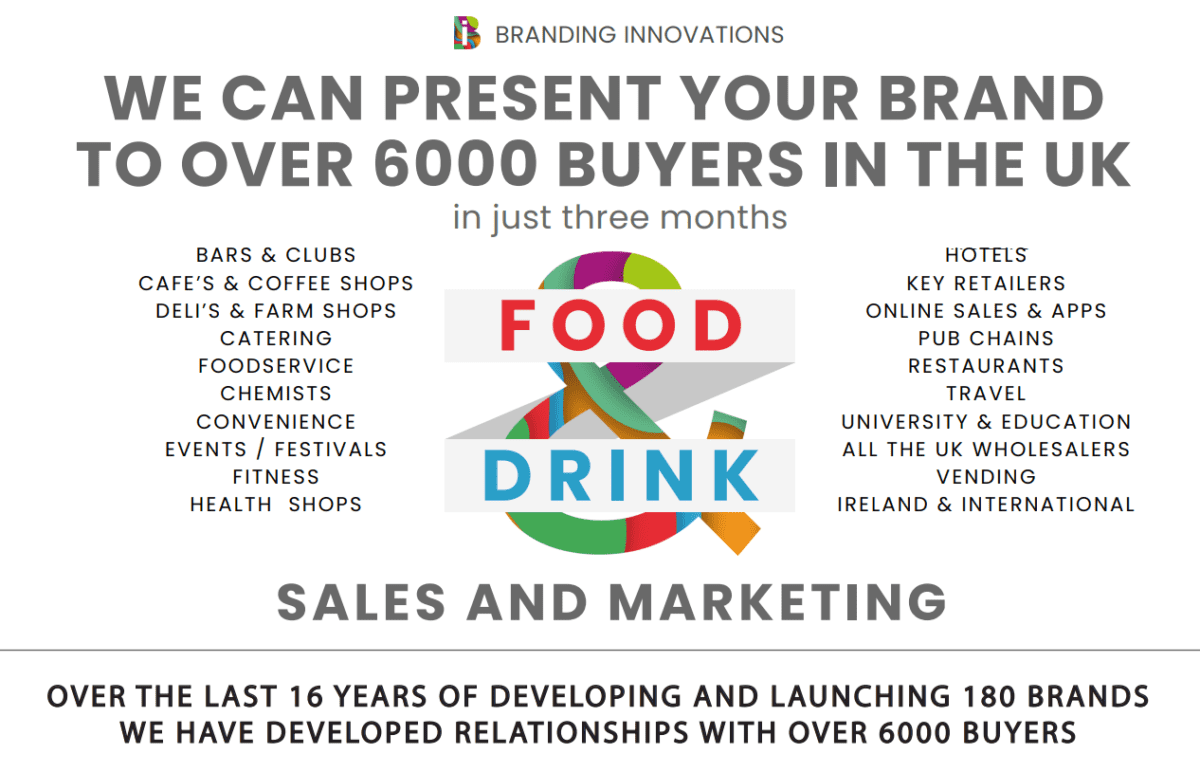
With an exclusive database of 6,500+ buyers built over 20 years, Branding Innovations gives every brand instant access to key retailers, wholesalers, and distributors — something that is impossible to achieve alone.
This buyer network covers major supermarkets, convenience chains, health stores, gyms, universities, foodservice operators, and online platforms. Every new brand gets a tailored target buyer list, a professional presentation, and a warm introduction strategy — the commercial multiplier that converts a great product into a listed, distributed, revenue-generating brand.
What Makes a Product Development Agency Genuinely Effective
Not every agency that calls itself a product development agency delivers what a food or drink brand actually needs. Here is the framework for evaluating genuine effectiveness.
Do they start with market research or with your recipe? A genuine product development agency validates the commercial opportunity before touching a formulation brief. An agency that jumps straight to recipe development is building backwards.
Do they manage compliance in-house? Novel Foods assessment, health claims review, and allergen labelling verification require specialist expertise — not an external consultant called in after the fact.
Do they offer brand development alongside product development? A product and a brand must be developed together. An agency that handles one without the other produces a result that is incomplete.
Do they have real buyer relationships? A product development agency without buyer access is a development shop with no route to commercial success. Ask specifically which buyers the agency has relationships with and how those relationships translate into client listings.
Can they prove results? Not capability claims. Actual commercial outcomes — brands launched, retailers secured, revenue generated.
The comparison below summarises what separates genuine full-service product development from partial alternatives:
| Approach | What It Delivers | What It Misses |
| Generic marketing agency | Campaign execution | Product development, compliance, buyer access |
| Freelance recipe developer | Formulation only | Brand strategy, compliance, production, buyers |
| Design agency | Visual identity | Product, compliance, production, buyers |
| Full-service food product development agency | Everything — under one roof | Nothing |
The 2026 Consumer: Your Product Must Win
Every product development decision must respond to what UK consumers are actively seeking right now.
By continuously developing products that cater to health, wellness, and sustainability trends, brands stay competitive and meet the evolving expectations of their target market. Without innovation, food businesses risk becoming outdated and losing consumer trust, which has a long-lasting impact on sales and brand loyalty.
Here is where UK consumer demand sits in 2026:
| Consumer Priority | What It Means for Product Development |
| Functional Benefits | Products must deliver a specific, credible health outcome |
| Clean Label | Short, recognisable ingredient lists — no artificial additives |
| Low or No Sugar | Natural sweeteners; SDIL-compliant formulation from the start |
| Gut Health | Prebiotic, probiotic, or fermented ingredient inclusion |
| Protein | Plant-based or whey protein claims drive purchase intent |
| Anti-UPF | Minimal processing; avoid artificial preservatives and colours |
| Sustainability | Traceable sourcing, sustainable packaging, ethical supply chain |
| Taste Above Function | Functional credentials never compensate for poor taste |
Flavour innovation in 2026 continues to surprise and stretch across categories. Fermentation technology, cocoa-free chocolate alternatives, plant-based challenger brands, and pickle flavours crossing into sweet profiles all reflect how adventurous and category-defying the UK consumer has become. Product development that responds to these signals builds products with built-in consumer relevance.
The Team Behind Every Product Branding Innovations Develops
Richard Horwell founded Branding Innovations after 35 years in FMCG across the UK, USA, Australia, and the Middle East. He has personally overseen the development and launch of over 200 food and drink brands worldwide.
Dr. Lilla Bessenyei is a qualified chemist specialising in nootropics, adaptogens, superfoods, and functional wellness ingredients. She leads all research, ingredient strategy, and regulatory compliance work — the expertise that protects every new product from the compliance errors that most commonly destroy launches.
Claire leads recipe development with 40 years of food science experience. She has taken hundreds of formulations from brief to commercially ready, retail-approved recipes — across beverages, functional drinks, and food products. The product must deliver on the brand promise. Claire’s work ensures it does, every time.
VitClear would not have been possible without the expertise from Richard, Lena, Dr Lilla, and the wider Branding Innovations team. As newcomers to the drinks industry, the team’s deep understanding of recipe development, branding, and product marketing played a fundamental role in shaping the business and navigating how buyers and distributors operate. Their straightforward, no-nonsense approach allowed VitClear to go from concept to distribution in just six months — showing just how clear and efficient the process is.
Actiph Water launched into Tesco, Sainsbury’s, Harrods, and Whole Foods simultaneously — going on to raise $9.8 million in total investment and export to 15 countries.
You can explore the full Branding Innovations service offering here or learn more about the recipe development process and brand development approach that underpin every product launch.
Frequently Asked Questions
What does a product development agency do for a food or drink brand?
A full-service product development agency manages every stage from concept to commercial launch, market research, recipe formulation, regulatory compliance, brand identity, packaging design, production management, and buyer introductions, all under one integrated brief.
How long does product development take for a food or drink brand in 2026?
With the right team and resources, a brand can go from concept to retail distribution in as little as six months. Without specialist support, the same journey typically takes 18 to 24 months with a significantly higher risk of errors at every stage.
Why can I not use my home recipe for commercial production?
A home recipe rarely survives commercial production without reformulation. Heat treatment, scale ratios, pH management, and shelf life requirements all change in an industrial environment. Professional reformulation ensures the product performs consistently across every production batch.
What regulations must a UK food or drink product comply with in 2026?
The key areas are Novel Foods, allergen labelling, health claims, HFSS classification, the Soft Drinks Industry Levy, and Extended Producer Responsibility for packaging. Every check must be completed before production begins.
How does a product development agency help with retail listings?
An agency with established buyer relationships provides direct access to decision-makers at major UK retailers, the warm introductions that convert a great product into a listed, distributed brand far faster than cold outreach ever can.
How does Branding Innovations differ from other product development agencies?
Branding Innovations combines market research, recipe development, regulatory compliance, brand identity, production management, and a buyer network of 6,500+ contacts under one roof, with over 200 brands launched worldwide since 2008.
Ready to Bring Your Idea to Market?
A great idea is the beginning. A great product development agency is what takes it the rest of the way through formulation, compliance, brand identity, production, and the buyer relationships that put it on the shelves where consumers can find it.
At Branding Innovations, the team treats every product as its own. They take on only projects with genuine market potential. They give honest feedback from the very first conversation. And they bring over 180 successful brand launches worth of expertise to every new brief.
If your idea is ready to become a product and your product is ready to become a brand, start with a free consultation today.
Read our Book for Guidance
Branding Innovations is a UK-based food and drink development and branding agency based in London. The team specialises in recipe development, brand strategy, packaging design, production management, and market launch, all under one roof. With over 200 brands launched worldwide since 2008, the agency brings real commercial experience to every new project.